
7 Best Plants to Grow With Strawberries in Raised Beds
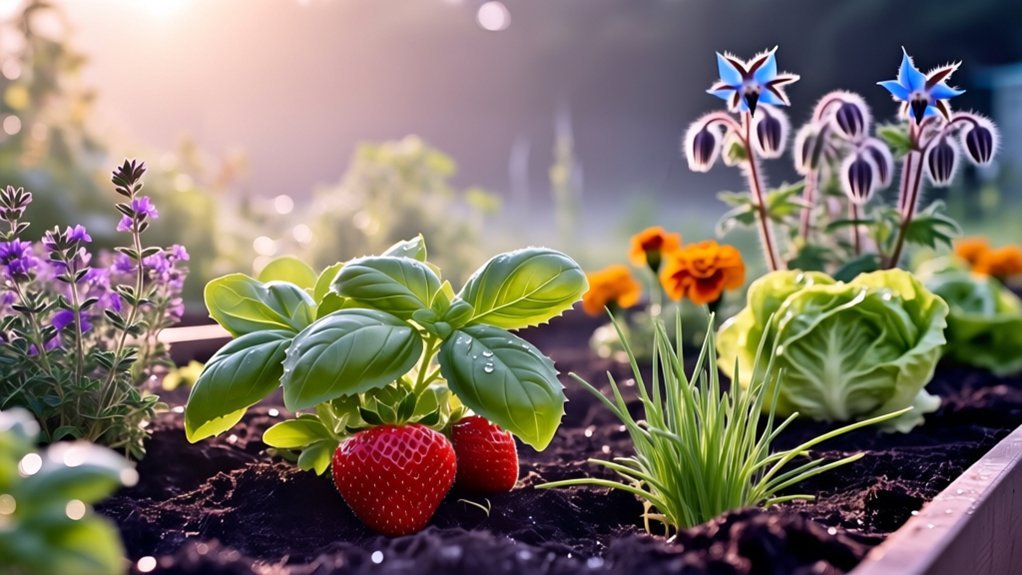
You’ll boost your strawberry harvest by planting companion herbs like thyme, sage, and mint that repel pests and attract pollinators. Add leafy greens such as spinach and lettuce to help retain soil moisture and suppress weeds.
Flowers like dill bring beneficial insects, while nitrogen-fixing plants strengthen growth. Avoid nearby nightshades or aggressive growers like mint itself to prevent competition.
With the right raised bed setup and proper spacing, you’ll create a thriving strawberry patch. Keep exploring and you’ll discover even more tips for success.
Benefits of Companion Plants for Strawberries in Raised Beds
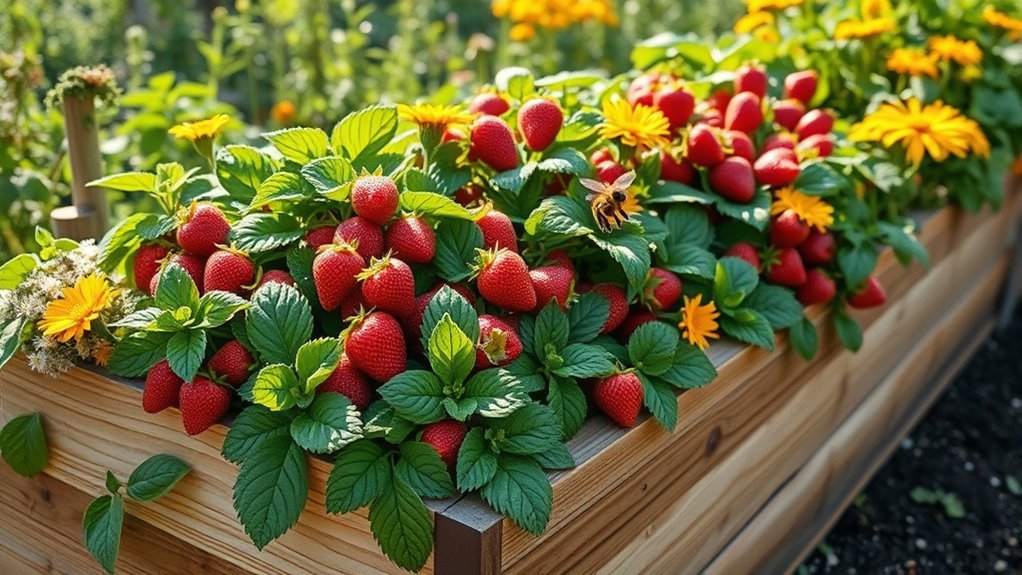
When you grow strawberries in raised beds, companion plants can boost their health and yield considerably. By choosing the right companion plants, you enhance garden health through improved soil fertility and weed suppression.
Companion plants in raised beds significantly improve strawberry health, yield, soil fertility, and weed control.
Herbs and flowers play an important role; herbs repel pests naturally, while flowers attract beneficial insects that support pest control around your strawberries.
Incorporating plants like spinach and lettuce helps conserve soil moisture, reducing weeds and maintaining a balanced ecosystem.
Nitrogen-fixing plants enrich the soil, promoting stronger strawberry growth. This diverse planting strategy creates a thriving environment where strawberries flourish, pests stay at bay, and the soil remains fertile.
Using companion plants in raised beds isn’t just smart gardening, it’s vital for maximizing your strawberry harvest efficiently and sustainably.
Best Herbs to Grow With Strawberries
You’ll find that certain herbs make excellent companions for strawberries because they help repel pests and attract pollinators.
Herbs like thyme, sage, and oregano don’t just protect your plants—they also boost fruit production by encouraging more pollination.
Top Companion Herbs
Growing the right companion herbs can boost your strawberry patch’s health and yield. Herbs like Thyme, Sage, Mint, Chives, and Dill attract pollinators and beneficial insects, helping your strawberry plants thrive. Their strong scents also confuse or repel pests, reducing damage without chemicals.
Here’s a quick guide:
| Herb | Benefit | Effect on Strawberry Plants |
|---|---|---|
| Thyme | Attracts beneficial insects | Improves pollination and yield |
| Sage | Strong scent masks strawberries | Confuses pests, attracts pollinators |
| Mint | Repels aphids and spider mites | Protects plants from pests |
| Chives | Attracts pollinators, deters pests | Enhances flavor and plant health |
| Dill | Attracts hoverflies | Supports pest control naturally |
Plant these herbs near your strawberries to naturally boost growth and reduce pest problems.
Pest-Repelling Herb Benefits
Although pests can threaten your strawberry plants, planting certain herbs nearby can keep them at bay naturally.
Using companion planting with pest-repelling herbs like thyme, sage, mint, oregano, and catnip helps protect your strawberries without chemicals.
Thyme attracts beneficial insects that boost strawberry health, while sage’s strong scent disrupts pests and draws pollinators.
Mint’s powerful aroma repels a variety of common pests, giving your plants natural defense.
Oregano not only deters harmful insects but also supports productivity by attracting helpful pollinators.
Catnip contains iridoids that effectively repel aphids and spider mites, preventing leaf damage.
Pollinator-Attracting Herb Choices
Five herbs stand out for attracting pollinators that boost your strawberry plants’ productivity.
Thyme’s flowers draw beneficial insects while its key ingredient, thymol, acts as a natural repellent, enhancing pest control.
Sage masks the scent of strawberry plants, making it harder for pests to find them, and attracts pollinators like bees during bloom.
Dill’s licorice scent distracts harmful insects and attracts hoverflies, which help manage pests naturally.
Borage is a magnet for various pollinators and beneficial insects, improving pollination and strawberry yield.
Catnip repels aphids and spider mites while still luring pollinators, making it a dual-purpose companion.
Growing these herbs alongside your strawberries creates a thriving ecosystem that supports pollinators and keeps pests in check.
Leafy Greens That Help Strawberries Thrive
Pairing strawberries with leafy greens can boost your garden’s health and productivity in several ways.
When you plant companion leafy greens like spinach, lettuce, Swiss chard, arugula, and mustard greens in your raised beds, you help your strawberry plants thrive.
Spinach and lettuce retain soil moisture and suppress weeds, acting as living mulch that benefits your strawberries.
Swiss chard provides ground cover that attracts beneficial insects, enhancing pest control naturally.
Arugula grows quickly and can be harvested before your strawberries mature, so they don’t compete for resources.
Mustard greens improve soil health and offer additional pest control benefits.
Flowers That Attract Pollinators and Protect Strawberries
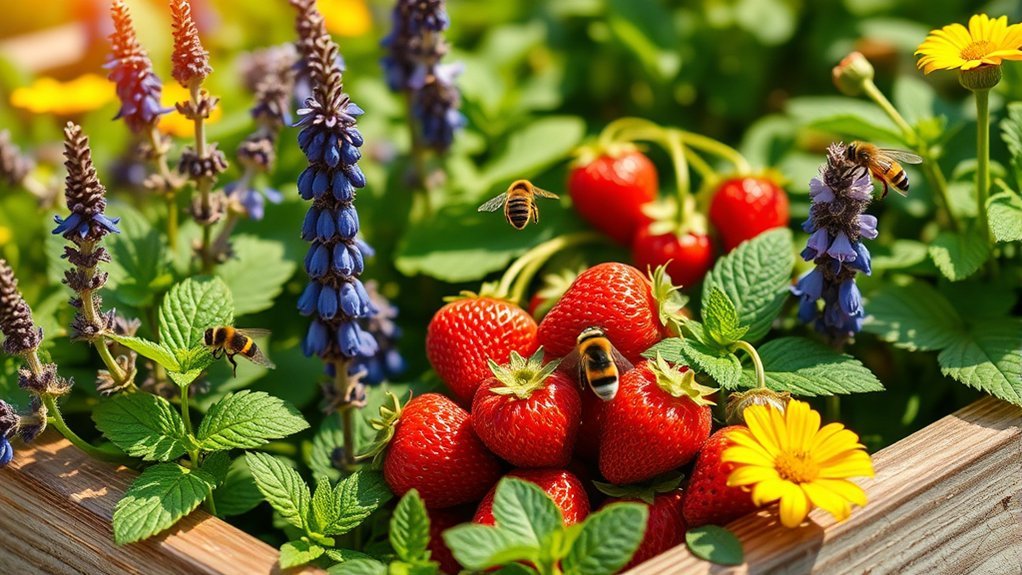
Beyond leafy greens, incorporating certain flowers into your strawberry beds can boost pollination and shield your plants from pests. Good companion plants like marigolds and lavender attract pollinators while their strong scents repel pests such as aphids and whiteflies.
Borage is another excellent choice, luring beneficial insects like parasitic wasps that protect strawberries naturally. Nasturtiums mask the scent of strawberries, helping to keep harmful pests away, while their vibrant blooms attract pollinators.
Sweet alyssum not only attracts honeybees and butterflies but also acts as a living mulch, suppressing weeds around your strawberries.
Including these strawberry companions in raised beds guarantees healthier plants by enhancing pollination and providing natural pest control.
Best Vegetable Companions for Strawberries in Raised Beds
When you plant vegetables like spinach and lettuce alongside your strawberries, you’ll not only suppress weeds and retain soil moisture but also help hide ripe berries from birds.
These strawberry companion plants act as good neighbors in your raised bed, improving soil quality and supporting organic gardening practices.
Strawberry companion plants enrich soil health and promote thriving, organic garden ecosystems in your raised bed.
Dill attracts beneficial insects like hoverflies that prey on pests like aphids, providing natural pest control without chemicals.
Asparagus adds nitrogen in the soil, enriching it without competing for nutrients.
Including alliums such as chives and garlic helps repel pests and suppress fungal diseases, keeping your strawberry plants healthy.
Plants to Avoid Near Strawberries
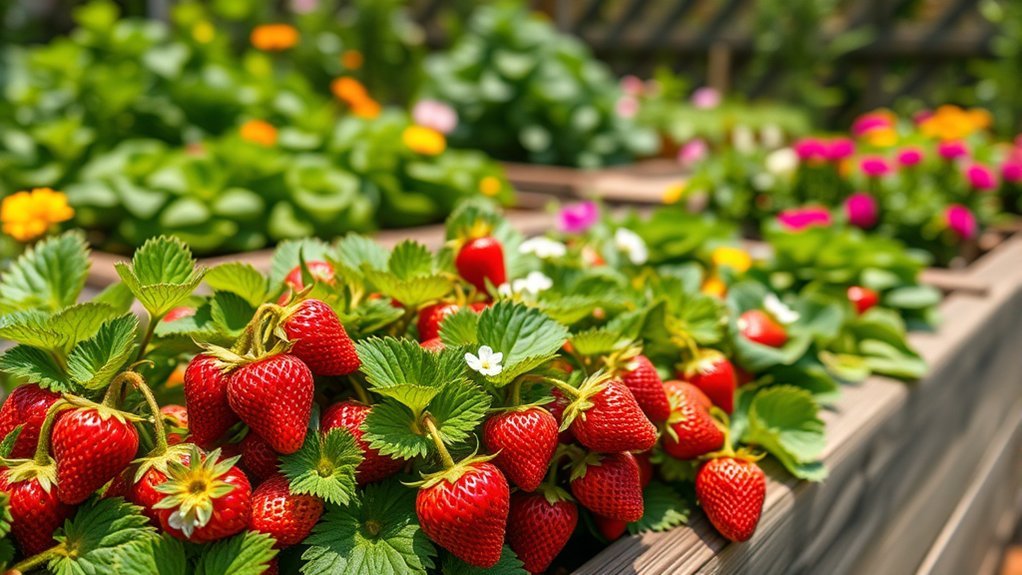
You’ll want to steer clear of certain plant families that can harm your strawberries, like nightshades, which are prone to spreading disease.
Also, it’s best to avoid plants that compete aggressively for nutrients and space—things like cucumbers, melons, and mint.
Keeping these plants away helps your strawberries thrive without unnecessary competition or risk.
Harmful Plant Families
Certain plants can harm your strawberries by competing for nutrients, spreading diseases, or overtaking their space.
Avoid planting members of the nightshade family like tomatoes, potatoes, eggplant, and peppers near your strawberries since they share susceptibility to diseases like verticillium wilt. This disease can spread easily between them.
Cruciferous vegetables such as cabbage, kale, and cauliflower can also stunt the growth of strawberries by competing aggressively for nutrients.
Mint is a poor neighbor because its aggressive growth can quickly invade your strawberry patch, choking out your plants.
Moreover, cucumbers and melons attract similar pests and compete for nutrients, while winter squash can overshadow strawberries and share susceptibility to verticillium wilt.
Keeping these harmful plant families apart helps protect your strawberries and guarantees they thrive in your raised beds.
Competitive Growth Issues
To keep your strawberries healthy, steer clear of plants that compete aggressively for nutrients, space, or light. Nightshade family plants like tomatoes, peppers, and eggplants can spread verticillium wilt, harming strawberry growth.
Avoid cruciferous vegetables such as cabbage and kale because they compete for nutrients and water, stunting your strawberries. Melons and cucumbers also compete for space and nutrients, limiting strawberry development.
Mint’s aggressive growth overshadows strawberries, making it a poor companion despite being plants that repel some pests.
Furthermore, okra and winter squash attract common pests that affect strawberries, complicating pest management in your raised beds.
Designing Raised Beds for Strawberries and Companions
How deep should your raised bed be for strawberries and their companions? Aim for at least 12 inches to support strawberry plants’ shallow roots while ensuring good drainage and airflow.
Proper spacing, 10 to 14 inches between plants and 1½ to 2 feet between rows, helps reduce disease risks and promotes air circulation.
When designing your raised beds, consider these tips: use soil amendments like compost to enrich soil with nutrients and maintain slightly acidic pH.
Choose companion plants with compact growth, such as spinach and lettuce, to aid moisture retention and suppress weeds.
Position the raised bed in full sun for at least 5-6 hours daily to support both strawberries and companion plants. This also helps attract beneficial insects naturally.
This setup optimizes growth and health for your strawberry garden.
Frequently Asked Questions
How Often Should I Water Strawberries and Their Companion Plants?
You should adjust your watering frequency based on companion plant needs, soil drainage, and weather effects.
During fruiting and hot weather, increase watering to support plant growth stages.
Use irrigation techniques like deep, infrequent watering to encourage strong roots and avoid root competition.
Mulch benefits moisture retention and reduces evaporation, helping with seasonal adjustments.
Always check soil moisture regularly to guarantee both strawberries and companions get enough water without overwatering.
Can Strawberries and Companions Be Grown in Containers Instead of Raised Beds?
Think of container gardening as crafting a mini garden oasis.
Yes, you can grow strawberries and their companions in containers! Choose strawberry container varieties suited for pots, pick a well-draining container soil mix, and guarantee containers are 12-18 inches deep.
Follow a seasonal planting guide, meet sunlight requirements, and use pest management strategies.
Fertilize container plants regularly, and enjoy easier harvesting techniques.
Companion plant benefits like pest control make this setup thrive beautifully.
What Soil pH Is Ideal for Strawberries and Their Companion Plants?
You want to maintain a soil pH between 5.5 and 6.8 for strawberries and their companions, ensuring ideal acidity levels and nutrient balance.
Regular pH testing helps you monitor this.
Use soil amendments like organic fertilizers and compost to improve soil drainage and boost microbial activity.
Mulch benefits moisture retention and temperature regulation.
Keep planting depth shallow to avoid root stress.
This approach supports companion compatibility and healthy growth in your raised beds.
How Do I Prevent Fungal Diseases When Growing Strawberries With Companions?
You’ll notice fungal prevention methods work best when you space plants properly, ensuring good air circulation techniques are in place.
Companion plant benefits, like alliums, help fend off diseases naturally.
Use crop rotation strategies to avoid soil pathogens, and prioritize soil drainage importance to keep roots healthy.
Mulching advantages and organic fungicides usage protect your plants further.
Combine pest management practices with disease resistant varieties, and follow plant spacing guidelines for a thriving strawberry patch.
When Is the Best Time to Plant Companion Plants With Strawberries?
You should start spring planting your seasonal companions once temperatures stay above 50°F, ensuring light requirements and nutrient timing align with strawberries.
Fast-growing plants fit well early on, while warm-season companions thrive during summer growth.
Planning in fall helps prepare soil for a healthy fall harvest.
Consider root depth to avoid competition, and choose pollination partners and pest control herbs to boost strawberry health throughout the season.
Conclusion
By choosing the right companions, you’ll boost your strawberries’ health and yield in your raised beds. No need for a crystal ball to see the benefits! Herbs like basil, leafy greens such as spinach, and colorful flowers attracting pollinators all work together to create a thriving garden.
Just steer clear of plants that compete with your strawberries. With a little planning and care, your raised bed will be a fruitful, buzzing oasis you’ll love tending every day.