
Is Strawberry a Flower?
You’re not looking at a flower when you see a strawberry; you’re seeing the fruit that develops from a flower’s multiple ovaries. Strawberry flowers have white petals and a yellow center where tiny ovaries grow into the seeds, called achenes, on the fruit’s surface.
The fleshy part you eat actually comes from the flower’s swollen base, not the ovaries themselves. If you want to better understand how pollination and flower structure create strawberries, keep exploring.
What Exactly Is a Strawberry: Fruit or Flower?
What exactly makes a strawberry a fruit rather than just a flower? When you look at a strawberry, you’re actually seeing an aggregate accessory fruit, not a true berry.
The red, fleshy part you enjoy isn’t derived from the flower’s ovaries but from the receptacle that swells after pollination.
The juicy red part of a strawberry grows from the flower’s swollen receptacle, not its ovaries.
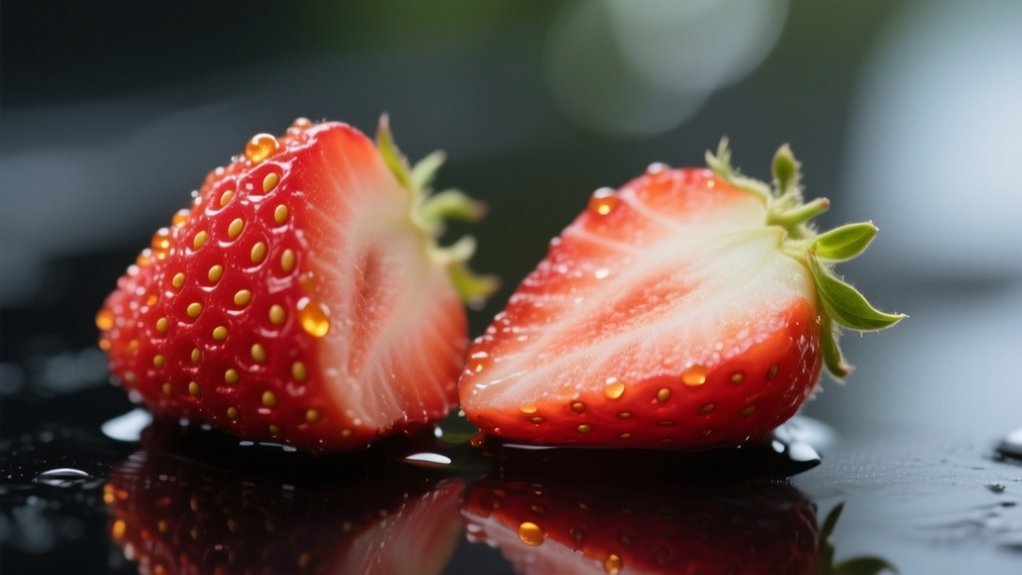
The tiny seeds on its surface, called achenes, are the true fruits containing the seeds.
So, while the strawberry flower plays an essential role in pollination and fruit development, the strawberry itself is an edible fruit formed from multiple ovaries embedded on the surface.
Understanding this helps you appreciate why what seems like just a tasty, juicy strawberry is actually a complex fruit developing from the flower’s reproductive parts.
How Do Strawberry Flowers Look and Develop?
Strawberry flowers play a key role in turning blooms into the fruit you enjoy. You’ll notice the flowers have white petals surrounding a yellow center, where the ovaries vital for fruit formation reside.
These flowers grow in small clusters on slender stalks and rely heavily on bees for pollination. Once pollinated, the ovaries swell and develop into the juicy fruit.
| Stage | Description |
|---|---|
| Flower Appearance | White petals, yellow center |
| Pollination | Bees transfer pollen |
| Fruit Development | Ovaries swell, green fruit forms |
| Ripening | Fruit changes color, matures |
Understanding this helps you appreciate how flowers become the delicious strawberry fruit you love.
Why Aren’t Strawberries True Berries?
You might think strawberries are berries, right? But actually, botanically speaking, they aren’t true berries. That’s because they develop from multiple ovaries of a single flower.
See, true berries come from just one ovary. Strawberries, on the other hand, are what we call aggregate accessory fruits.
And if you look closely, you’ll notice their seeds are on the outside, which is pretty unique.
So, understanding this difference really helps you see why strawberries have a different fruit structure compared to, say, blueberries or tomatoes.
It’s kind of interesting once you think about it!
Botanical Definition Of Berries
Although they seem like typical berries, strawberries don’t meet the botanical criteria that define true berries. When you look at a strawberry (Fragaria), you’re actually seeing an aggregate fruit, not a true berry.
True berries develop from a single ovary and have seeds embedded within the flesh. Strawberries differ because they form from multiple ovaries of one flower, making them aggregate fruits.
Also, their fleshy part grows from the flower base, not the ovary. Their seeds, called achenes, sit on the surface rather than inside. True berries, like blueberries, come from a single ovary.
Aggregate Versus True Berries
When you compare aggregate fruits to true berries, their structural differences become clear.
Strawberries are aggregate accessory fruits, meaning they develop from multiple ovaries of a single flower, unlike true berries that come from a single ovary.
The fleshy part you enjoy in a strawberry isn’t the fruit itself; it’s the swollen receptacle of the flower. The tiny seeds on the surface, called achenes, are the actual fruits.
True berries like blueberries or bananas form from one ovary and usually contain multiple seeds inside the fleshy part.
So, while strawberries look like berries, their unique development as an aggregate accessory fruit sets them apart from true berries, which have a simpler, single-ovary structure.
This botanical distinction explains why strawberries don’t fit the true berry category.
Strawberry Fruit Structure
Strawberries stand out because their fleshy part develops from the flower’s receptacle, not the ovary like true berries. When you look at a strawberry plant, you’re actually seeing aggregate accessory fruits at work.
Unlike true berries, strawberries form from multiple ovaries in one flower. Each tiny seed-like achene on the strawberry’s surface is a separate fruit containing a seed. This unique structure means strawberries don’t fit the botanical definition of a berry.
Consider these key points about strawberry fruit structure:
- The fleshy part is from the receptacle, not the ovary
- Small achenes are the true fruits with seeds
- Multiple ovaries form the strawberry’s aggregate fruits
- Strawberries are classified as aggregate accessory fruits
- True berries develop from a single ovary, unlike strawberries
How Do Strawberry Flowers Turn Into Fruit?
If you watch closely, you’ll see that strawberry flowers rely on bees to transfer pollen, which triggers the ovaries in the yellow center to swell and start forming fruit.
Each small white flower cluster on slender stalks contains multiple ovaries that, once fertilized, develop into the tiny achenes you see as seeds on the strawberry’s surface.
Curiously, the juicy, edible fruit you enjoy isn’t from the ovaries themselves but from the enlarged flower receptacle that grows around them.
As the ovaries swell and mature, the receptacle expands, turning into the fleshy part of the strawberry.
This transformation from flower to fruit happens thanks to the flower’s structure and the essential pollination step, ultimately giving you the sweet, edible fruit you love to eat.
What Role Does Pollination Play in Strawberry Growth?
You’ll find that pollination is key to turning strawberry flowers into juicy fruit.
When bees transfer pollen to the flower’s center, it triggers the ovaries to grow and shape the strawberry.
Without this process, your strawberries mightn’t develop fully or taste as good.
Pollination Process Explained
Because pollination triggers the transformation of strawberry flowers into fruit, understanding its role is key to appreciating how strawberries grow.
The pollination process is essential for producing the edible strawberry fruit you enjoy.
Bees transfer pollen from the stamen to the ovaries nestled in the flower’s yellow center, initiating fruit development. The flower’s white petals attract these pollinators, boosting success rates.
Key points to know about the pollination process:
- Ovaries swell after pollination, forming the juicy fruit.
- Sepals remain attached, becoming part of the fruit.
- Achenes on the surface are the true fruits.
- Bees are the primary pollinators.
- Effective pollination guarantees better fruit quality.
Impact On Fruit Formation
Understanding how pollination works helps you see why it plays such a big role in strawberry growth. When bees transfer pollen from the stamens to the ovaries in the flower’s yellow center, they trigger the ovaries to swell. This swelling leads directly to fruit formation, shaping the juicy strawberry you enjoy.
Without effective pollination, the fruit may develop poorly or not at all. Each flower can produce multiple fruits, with tiny achenes embedded in the enlarged receptacle after pollination.
The quality and quantity of your strawberries depend heavily on how well pollination occurs, impacting both yield and flavor.
What Are the Key Parts of a Strawberry Plant?
While exploring a strawberry plant, you’ll notice several key parts that work together to support its growth and fruit production.
Like many flowering plants, strawberry plants have distinct structures that play crucial roles in their life cycle.
Here are the main parts you’ll find:
- Fibrous roots: Anchor the plant and absorb water and nutrients from the soil.
- Crown: A shortened stem where basal leaves grow, aiding overall development.
- Compound leaves: Usually three sawtooth-edged leaflets that help with photosynthesis.
- White flowers: Clustered on slender stalks, containing reproductive organs for pollination.
- Fleshy fruit: The accessory fruit that develops from the enlarged flower receptacle, housing true fruits inside.
Understanding these parts helps you appreciate how strawberry plants thrive and produce fruit.
What Are Achenes and Why Do They Matter?
You mightn’t realize it, but those tiny seed-like dots on a strawberry’s surface are called achenes. Each achene is actually a true fruit that develops from the flower’s ovary after pollination.
It’s pretty interesting when you think about it! Understanding achenes helps you see how strawberries reproduce and grow beyond just the juicy part you eat.
Definition Of Achenes
Because achenes are the tiny, dry fruits embedded on the surface of a strawberry, they play a key role in defining what the fruit actually is.
These achenes are single-seeded fruits that develop from the flower’s ovaries, making the strawberry an aggregate fruit rather than a true berry.
The fleshy part you enjoy is actually an accessory fruit, growing from the flower’s receptacle.
Understanding achenes helps you grasp strawberry biology better. Here are five important points about achenes:
- Each achene contains one seed.
- Achenes form from separate ovaries of the flower.
- They contribute to the strawberry’s unique texture and look.
- Achenes enable seed dispersal for reproduction.
- Their number affects the fruit’s size and yield.
Recognizing achenes clarifies why strawberries are more than just sweet, juicy fruits.
Role In Fruit Development
Although strawberries look like simple fruits, their development relies heavily on achenes, the tiny seed-like structures you see on their surface. Each achene is actually a true fruit containing a seed, developing from an individual ovary of the flower.
Meanwhile, the fleshy part you eat is derived not from the ovary but from the enlarged receptacle. This makes the strawberry an aggregate accessory fruit rather than a true berry.
These achenes play an essential role in reproduction because they hold the seeds that can grow into new plants when dispersed. The number of achenes varies widely, influencing the strawberry’s size and appearance.
Understanding achenes helps you appreciate the strawberry’s unique fruit development and its complex botanical structure.
How Do Strawberry Flower Varieties Affect Fruit Quality?
When you choose different strawberry flower varieties, you’ll notice they directly affect fruit quality by shaping pollination success and flowering patterns.
The flowering habits of a variety influence both the timing and amount of fruit you get, while pollination efficiency impacts size and flavor.
Flowering habits shape fruit timing and yield, while pollination quality enhances size and flavor.
Here’s what matters most:
- Bee-pollinated flowers tend to produce larger, more flavorful fruit quality.
- Varieties with distinct flower size and fragrance attract diverse pollinators, improving fruit set.
- Short-day, long-day, and day-neutral flowering habits determine when and how much fruit develops.
- Disease-resistant flower varieties reduce plant stress, boosting nutrient uptake and fruit quality.
- Longer flowering duration and healthier plants yield better quality and quantity of strawberries.
What Are Common Misconceptions About Strawberries and Flowers?
You might be surprised to learn that strawberries aren’t true berries, despite what their name suggests. One common misconception is thinking the strawberry itself is a single fruit, when it’s actually an aggregate accessory fruit.
The fleshy part you enjoy comes not from the flower’s ovary but from the receptacle, a modified flower part called the hypanthium. The tiny seed-like dots on the strawberry’s surface are achenes, each a true fruit containing a seed.
Many also assume all fruits develop solely from the ovary, but strawberries defy this by developing mostly from accessory tissues.
Understanding these misconceptions helps you appreciate how unique strawberries are among fruits and clarifies the important role strawberry flowers play in their development.
Can Strawberry Flowers Be Used Beyond Fruit Production?
Strawberry flowers play a key role in fruit development, but their uses extend well beyond that.
You can enjoy these edible blooms in various culinary ways that add both flavor and aesthetic appeal. Here’s how you might use strawberry flowers beyond just fruit production:
Garnish dishes and cocktails with their delicate, vibrant petals.
Infuse syrups and teas for a subtle, aromatic strawberry flavor.
Toss them in salads for a fresh, colorful touch.
Candy the petals for unique dessert decorations.
Encourage pollinators by planting flowers to support ecosystem health.
Frequently Asked Questions
Are Strawberry Flowers Edible or Used in Cooking?
Yes, strawberry flowers are edible and have various culinary applications. You can use their delicate flavor and attractive appearance in salads, desserts, or as garnishes to enhance your dishes.
They’re also great for infusing syrups or brewing herbal teas, adding a unique floral note.
Incorporating strawberry flowers into your cooking not only adds color and fragrance but also offers beneficial phytochemicals, making them a versatile ingredient beyond just the fruit.
How Long Do Strawberry Flowers Typically Bloom?
Strawberry flowers typically have a flowering duration of about 4 to 7 days during their blooming stages.
You’ll notice each flower opens fully, allowing pollination before it starts developing into fruit.
The entire plant’s flowering duration can last 4 to 6 weeks in spring, depending on your region.
If you grow day-neutral varieties, you might see continuous blooming stages and fruit production throughout the growing season, as long as conditions stay favorable.
Can Strawberry Plants Produce Fruit Without Flowers?
You can’t expect fruit production from a strawberry plant without flower development, just like you can’t bake bread without yeast.
The flowers are essential because they hold the reproductive parts needed for pollination and fertilization.
Without flowers, the plant might grow runners and leaves, but it won’t produce any fruit.
What Environmental Conditions Best Support Strawberry Flower Growth?
You’ll want to keep soil moisture consistent but well-drained to support strawberry flower growth, preventing drought stress while avoiding waterlogging.
Maintain a temperature range between 60°F and 80°F, as strawberries thrive in moderate conditions.
Also, guarantee the soil is rich in organic matter with a pH of 5.5 to 6.8.
Don’t forget to provide at least 6-8 hours of sunlight daily to encourage healthy flowering and fruiting.
Do Strawberry Flowers Attract Specific Pollinators?
You might expect all pollinator species to visit any flower, but strawberry flowers specifically attract bees due to their unique flower characteristics.
Their white petals and accessible nectar make them stand out among other plants.
While many insects pollinate, bees are the primary pollinator species drawn to strawberries, ensuring effective pollination.
This selective attraction boosts fruit production, showing how flower traits directly influence which pollinators you’ll see buzzing around your strawberry patch.
Conclusion
As you watch a strawberry blossom unfold its delicate white petals under the warm sun, remember it’s more than just a flower. It’s the starting point of the juicy fruit you love.
Those tiny achenes dotting the red surface are seeds, each telling a story of growth and transformation. So next time you bite into a strawberry, imagine the flower’s journey, blooming and turning into that sweet, vibrant treasure in your hand.