
What Makes a Strawberry Moon Rare?
You’ll find a Strawberry Moon rare when it coincides with a major lunar standstill, like in 2026, which makes the Moon follow a much lower path across the sky. This low trajectory lets the Moon appear larger and glow with vibrant red or orange hues due to atmospheric scattering.
Such an event only happens every 18.6 years and won’t happen again for decades. Keep exploring to discover what causes these stunning effects and when the next one will grace the horizon.
What Is a Strawberry Moon and When Does It Happen?
The Strawberry Moon is the full moon that appears in June, named by Native American tribes to mark the peak ripeness of wild strawberries ready for harvest.
You’ll notice it signals the shift from spring into summer, occurring once every 29.5 days like any full moon, but the Strawberry Moon specifically happens in June.
What makes the 2025 Strawberry Moon stand out is its connection to a major lunar standstill, a rare event that causes the moon to reach its lowest position in the sky since 2006.
While the name might make you think the moon glows red, it actually highlights the cultural importance of strawberry harvesting during this time.
How Did the Strawberry Moon Get Its Name?
You might be wondering why it’s called the Strawberry Moon.
Well, Native American Algonquian tribes gave it this name because it marked the peak time for harvesting wild strawberries in June.
It’s pretty cool how different cultures link the moon’s phases to seasonal changes and important harvests, right?
Native American Origins
Although many mightn’t realize it, the name “Strawberry Moon” comes from Native American Algonquin tribes who marked June’s full Moon as the time when wild strawberries reached peak ripeness for harvest.
You can appreciate how these Native American communities used lunar names like Strawberry Moon to track seasonal changes vital for survival.
Different tribes had their own names too; for example, the Haida called it the “Berries Ripen Moon,” highlighting the cultural significance of this period.
By naming the Moon after natural events, Native American people connected their agricultural activities and harvesting schedules directly to lunar cycles, emphasizing nature’s rhythms.
Understanding these origins helps you see the Strawberry Moon as more than just a pretty sight. It’s a symbol of abundance and tradition rooted deeply in Native American heritage.
Seasonal Harvest Significance
Since wild strawberries reach their peak ripeness in June, Native American Algonquin tribes named the full moon during this time the Strawberry Moon. This signaled the start of their harvest season.
This name highlights how closely lunar phases align with seasonal changes and agricultural cycles.
You can appreciate the Strawberry Moon’s significance by considering these points:
- It marks the shift into summer and the perfect time for berry-picking.
- The moon acts as a natural calendar, guiding harvest efforts tied to nature’s rhythms.
- Its timing reminds you of the deep relationship between the moon’s phases and traditional farming practices.
Cultural Naming Traditions
When you explore the origins of the Strawberry Moon‘s name, you find it rooted in Native American Algonquian traditions that linked the full moon in June to the peak ripeness of wild strawberries.
The Strawberry Moon name reflects a cultural practice of marking seasonal changes and agricultural cycles.
Full Moon names like this served as natural calendars, guiding communities in their harvesting activities.
Different tribes had their own names for June’s full moon: the Anishinaabe called it the Blooming Moon, the Cherokee named it the Green Corn Moon, and the Haida referred to it as the Berries Ripen Moon.
Each name highlights unique environmental cues important to those cultures.
Why Does the Strawberry Moon Mark Seasonal Changes?
You can use the Strawberry Moon to track seasonal harvests because it signals when wild strawberries are ripe.
It’s pretty neat how many cultures rely on lunar calendars like this to time their planting and gathering.
Nature’s rhythmic signals, like this full moon, really help you stay in sync with the changing seasons.
Tracking Seasonal Harvests
Although the Strawberry Moon shines brightly in June, it does more than light up the night sky. It signals key seasonal changes that impact farming and harvesting.
When you see this full Moon, you know it’s time to track seasonal harvests closely. Here’s why it matters:
- The full Strawberry Moon marks peak ripeness for wild strawberries, signaling the best time to harvest.
- It aligns with the start of summer, guiding farmers to adjust planting and harvesting schedules.
- This lunar cue helps you anticipate other crop cycles, ensuring timely gathering and preserving of seasonal produce.
Cultural Lunar Calendars
Since many cultures relied on lunar calendars to guide their agricultural activities, the Strawberry Moon’s timing holds deep significance.
Cultural lunar calendars use full moon phases to mark important seasonal changes, especially for farming.
The Strawberry Moon, named by Native American tribes, signals the peak ripeness of June-bearing strawberries and the start of summer harvests.
Other cultures, like the Anishinaabe, call it the Blooming Moon, reflecting nature’s shifts.
These names helped communities track when to plant, harvest, and prepare for seasonal cycles.
By aligning agricultural tasks with lunar phases, cultural lunar calendars created a natural rhythm for managing crops.
When you notice the Strawberry Moon, you’re seeing more than just a full moon.
You’re witnessing a centuries-old system that links the moon’s glow with the land’s bounty.
Nature’s Rhythmic Signals
When the Strawberry Moon rises, it signals more than just a full lunar phase. It marks nature’s precise timing for seasonal change. This full Moon coincides with the lunar standstill, a natural rhythm affecting the Moon’s path and visibility.
You can see how the Strawberry Moon serves as a reliable seasonal signal by noting:
- It highlights the peak ripeness of wild strawberries, signaling summer’s start and harvest time.
- It aligns with Native American agricultural calendars, guiding planting and gathering based on lunar cycles.
- It marks the shift from spring to summer, synchronizing natural events like plant blooming and animal behaviors.
What Makes the 2026 Strawberry Moon So Rare?
While the 2026 Strawberry Moon won’t hang as low in the sky as the 2025 one did, its rarity lies in the unique visual effects created by its specific position on June 29 at 7:56 P.M. You’ll notice that, unlike the 2025 full moon influenced by a major lunar standstill, this moon’s height alters how you see it.
The Strawberry Moon, named by Algonquin tribes for strawberry harvest time, signals seasonal change. Here’s a quick look at what makes 2026’s event unique:
| Date | Time (ET) | Moon Height |
|---|---|---|
| 2024 | June 23 | Moderate |
| 2025 | June 14 | Extremely Low |
| 2026 | June 29 | Higher, Visual Effects |
| 2027 | June 18 | Moderate |
| 2028 | June 6 | Low |
You’ll appreciate the distinct spectacle this moon offers.
How Does the Major Lunar Standstill Lower the Moon’s Path?
You’ll notice that the Moon’s path changes quite a bit during the major lunar standstill cycle, which happens every 18.6 years.
This shift affects where the Moon rises and sets along the horizon, making it seem like it’s lower in the sky.
If you think about the gravitational forces at play, it helps explain why the Moon’s position changes so much over time.
Lunar Standstill Cycle
Because the Moon’s orbit tilts under the Sun’s gravitational influence, major lunar standstills occur every 18.6 years. This causes the Moon to take an unusually low path across the sky.
This lunar standstill cycle affects the visibility and position of full moons like the Strawberry Moon.
Here’s what happens during this cycle: The Moon’s orbit shifts, lowering its path and making it appear closer to the horizon. The 2025 Strawberry Moon will be especially low, a rare event not seen again until 2043.
You’ll notice a pronounced Moon illusion, where the Moon looks larger near the horizon due to its lowered position.
Understanding this cycle helps you appreciate why some Strawberry Moons stand out as unique celestial events.
Moonrise And Moonset Shift
As the major lunar standstill approaches, you’ll notice the Moon rising and setting at much lower angles on the horizon than usual.
This event, occurring every 18.6 years, causes the Moon to reach its extreme northernmost and southernmost positions, markedly lowering its path across the sky.
During this time, the moonrise and moonset positions shift dramatically, moving more quickly than the Sun’s, which makes the Moon appear closer to the horizon.
Because of this, the Strawberry Moon you see in 2025 will trace a uniquely low path, enhancing its visual impact.
This lower trajectory not only changes where and when you spot the Moon but also amplifies the stunning illusion of size when it’s near the horizon during the major lunar standstill.
Gravitational Effects Explained
The shifting moonrise and moonset angles you notice during a major lunar standstill happen because of complex gravitational forces at play. This rare event, occurring every 18.6 years, causes the Moon to reach extreme northern and southern positions.
Here’s how it lowers the Moon’s path:
- The Sun’s gravitational pull interacts with Earth’s tilted axis, altering the Moon’s orbit.
- This interaction changes the Moon’s angle, making it rise and set closer to the horizon.
- As a result, you see a low Moon that appears larger and more colorful, like the 2025 Strawberry Moon.
Understanding these effects helps you appreciate why the lunar standstill dramatically shifts the Moon’s visibility and creates such a rare, striking sight.
Why Will the Strawberry Moon Appear So Low in 2026?
When you spot the Strawberry Moon in 2026, you’ll notice it hanging unusually low in the sky, thanks to a rare lunar event called a major standstill.
This lunar standstill happens roughly every 18.6 years and causes the Moon to reach its northernmost and southernmost points along its orbit.
Because of this, the Moon’s rise and set positions shift dramatically, placing the 2026 Strawberry Moon at an exceptionally low position near the horizon.
You won’t see it this low again until 2043, making it a unique opportunity.
To fully appreciate the Moon’s low position and its striking appearance, find a clear view of the southeast horizon during its peak brightness.
This rare alignment enhances the Moon’s visual impact in the night sky.
How Does the Atmosphere Change the Strawberry Moon’s Color?
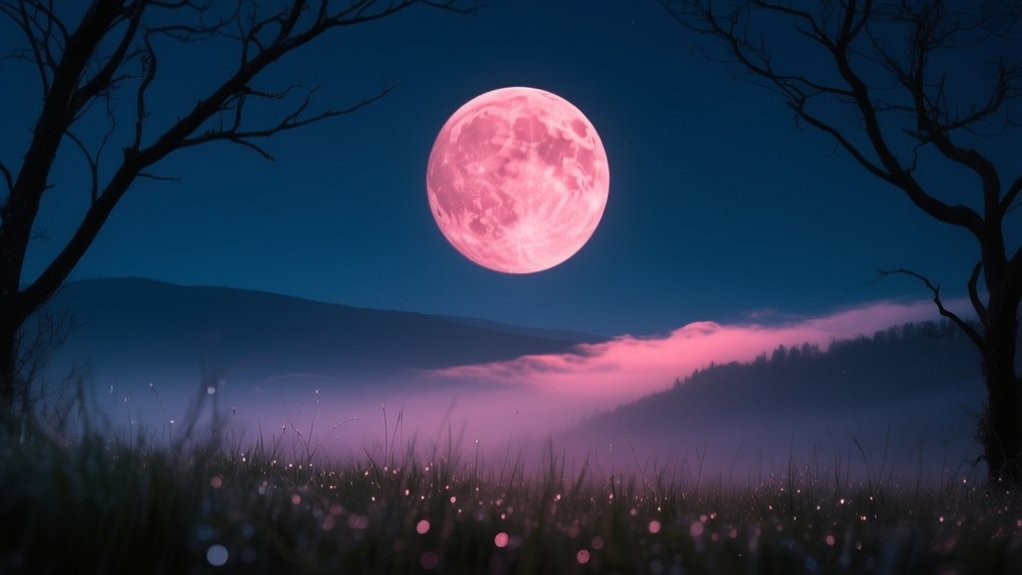
You might notice the Strawberry Moon glowing with a red or orange tint, especially when it hovers low near the horizon like it will in 2026.
This color change happens because of atmospheric scattering. As the Moon’s light travels through thicker layers of the atmosphere, shorter wavelengths like blue scatter away, leaving the longer red or orange wavelengths more visible.
The effect depends on three key factors:
- The Moon’s low angle increases scattering intensity.
- Atmospheric conditions such as humidity, dust, or pollution enhance the color shift.
- Viewing the Moon shortly after it rises captures the most vivid hues.
Why Does the Strawberry Moon Look Bigger Near the Horizon?
Although the Strawberry Moon often looks larger near the horizon, it’s actually an optical illusion called the moon illusion at work. When you see the Moon close to the Earth’s surface, your brain compares it to nearby objects like trees or buildings. This makes it seem much bigger than when it’s high in the sky.
This effect becomes even more striking during a major lunar standstill, such as the one in 2025, when the Moon appears particularly low on the horizon. The atmosphere also scatters the Moon’s light, enhancing its size and color.
How Can You Best Spot and Enjoy the Low-Lying Strawberry Moon?
The low-horizon Strawberry Moon offers a stunning visual treat that’s best enjoyed from an open spot with a clear view of the southeast sky.
To make the most of this rare lunar standstill event, follow these tips:
- Choose locations like fields or coastlines where the horizon is unobstructed, ensuring you catch the Moon rising just after sunset on June 10, 2025.
- Bring binoculars to enhance details, but don’t forget to appreciate the Strawberry Moon’s natural beauty with your naked eye.
- Capture the moment by photographing the Moon’s impressive size and warm orange hue; check guides for effective techniques.
Since this low-lying Strawberry Moon won’t return until 2043, take your time to enjoy this unique spectacle fully.
When Will the Next Major Lunar Standstill Happen After 2026?
Wondering when the next major lunar standstill will take place after 2026? You’ll have to wait until 2043 for this significant event.
Major lunar standstills occur about every 18.6 years, marking the Moon’s northernmost or southernmost positions along the horizon.
During a major standstill, the Moon’s path stretches to its maximum range between moonrise and moonset, offering unique and breathtaking viewing opportunities.
Since the 2025 Strawberry Moon will be the lowest full Moon until then, it highlights just how rare these moments are.
When the 2043 major standstill arrives, expect dramatic changes in the Moon’s appearance and trajectory.
It will be a must-watch event for any lunar enthusiast.
Frequently Asked Questions
Can the Strawberry Moon Affect Tides or Weather Patterns?
Yes, the Strawberry Moon can cause tide variations because its full moon phase increases the Moon’s gravitational pull. This leads to higher high tides and lower low tides, especially if it’s near perigee.
However, you shouldn’t expect it to trigger weather anomalies.
Scientific studies show lunar phases don’t directly affect weather patterns, so any claims about storms or unusual weather during a Strawberry Moon are mostly folklore without solid evidence.
Are Strawberry Moons Visible Worldwide or Only in Specific Regions?
You can see Strawberry Moons globally, as they’re a full moon phase visible from anywhere on Earth with clear skies.
While their global visibility is universal, the regional significance varies widely. Different cultures give this full moon unique names and meanings.
For example, Native American tribes named it for strawberry harvests.
How Do Indigenous Cultures Interpret the Strawberry Moon?
You’ll find that indigenous cultures interpret the Strawberry Moon with deep lunar significance, connecting it to nature’s cycles and agricultural rhythms.
Many hold indigenous ceremonies during this time to honor the ripening of berries and the changing seasons.
These rituals celebrate the Moon’s role in tracking time and sustaining life, reflecting a profound respect for the environment.
What Equipment Is Best for Photographing a Strawberry Moon?
You’ll want a DSLR camera with a telephoto lens, 200mm or longer is perfect to capture the Strawberry Moon’s details.
Using manual camera settings lets you fine-tune ISO, aperture, and shutter speed for ideal exposure.
Don’t forget a sturdy tripod to prevent blur during longer exposures, and a remote shutter release or timer to avoid shake.
If you want a creative shot, try a wide-angle lens to include interesting foreground elements.
Does the Strawberry Moon Influence Animal Behavior or Plant Growth?
Yes, the Strawberry Moon can influence animal activity and plant blooming.
You’ll notice that many animals become more active during this full moon because the brighter nights make it easier for them to move around.
You might also observe certain plants timing their blooming cycles with the lunar phases, including the Strawberry Moon.
While not all scientific studies agree, many gardeners and researchers see a link between moon phases and natural behaviors.
Conclusion
As you look up at the 2026 Strawberry Moon, remember it won’t just shine bright. It’ll follow a path lowered by a rare major lunar standstill that happens only once every 18.6 years.
Imagine the moon hanging unusually low, glowing bigger and redder than usual. It will paint the night sky with a stunning seasonal signal.
Don’t miss this cosmic event. It’s a rare chance to witness nature’s quiet, beautiful rhythm in action.