

What Factors Affect How a Strawberry Grows?
You’ll need to manage soil quality, aiming for a pH of 5.8 to 6.5 with good organic matter and drainage to keep strawberry roots healthy. Make sure your site gets full sun and maintains ideal temperatures between 20-27°C during the day.
Water consistently, using drip irrigation to avoid disease risks, and keep pests in check with good airflow and crop rotation. By balancing these factors, you’ll boost growth and fruit quality. Explore more to master each step for bountiful harvests.
How Soil Quality Affects Strawberry Growth and Yield?
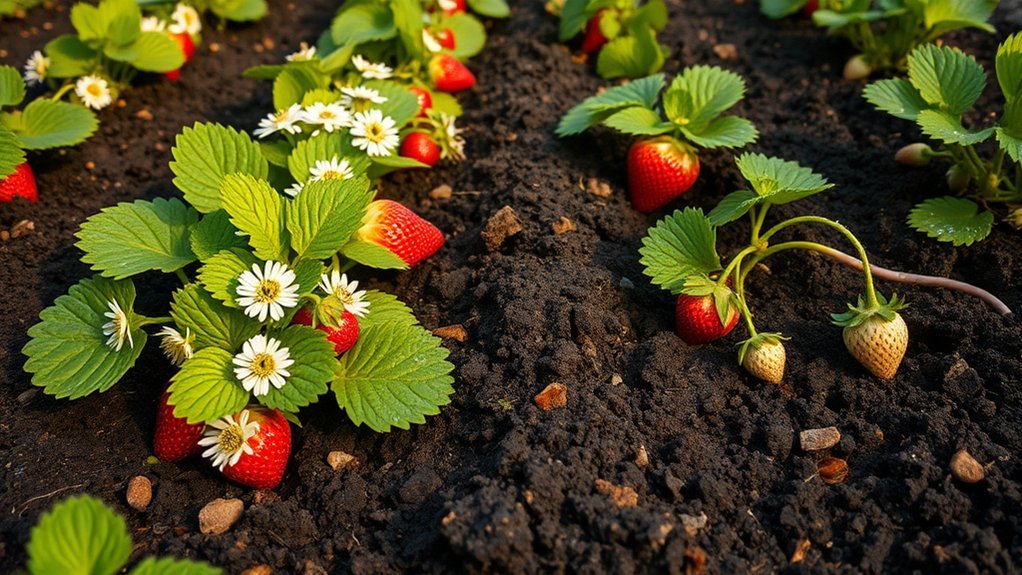
Although many factors influence strawberry growth, soil quality plays a crucial role in determining both plant health and yield. You need to focus on soil pH, aiming for a range of 5.8 to 6.5 to guarantee ideal nutrient availability.
Incorporating around 6% soil organic matter helps retain moisture and supplies essential nutrients. Don’t skip soil testing; it reveals nutrient deficiencies that could stunt growth and reduce fruit quality.
Strawberries thrive best in well-drained soils, so avoid waterlogged areas to prevent root rot. Practicing crop rotation is important to avoid disease buildup. Never plant strawberries in the same soil for more than five years.
Why Does Soil pH Matter for Healthy Strawberries?
Why does soil pH matter so much for healthy strawberries? Soil pH directly influences nutrient availability, which is essential for plant health and fruit quality.
Strawberries thrive best in a pH range of 5.8 to 6.5, where vital nutrients like phosphorus remain accessible. If soil pH drops below 6.0, key nutrients become locked up.
Strawberries flourish in soil pH 5.8 to 6.5, ensuring vital nutrients like phosphorus stay available.
On the other hand, a pH above 7.0 can cause deficiencies in iron and manganese, leading to poor growth and chlorosis.
Maintaining the right soil pH through regular soil testing helps you adjust conditions for ideal strawberry cultivation. Proper pH management not only boosts nutrient uptake but also leads to high yields and stronger resistance to diseases.
Paying attention to soil pH guarantees your strawberries grow healthy and produce delicious fruit.
How to Pick the Best Site for Growing Strawberries?
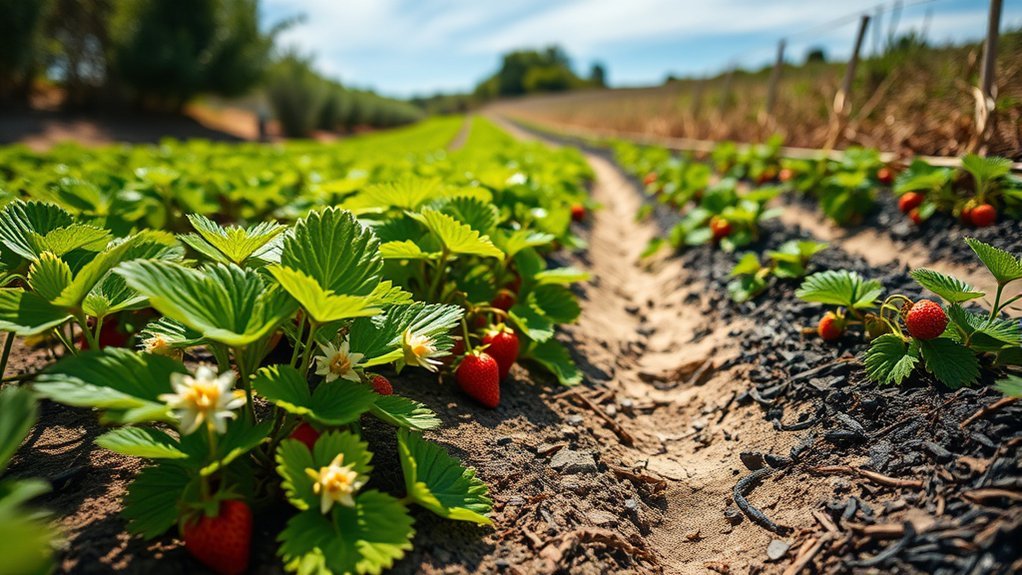
You’ll want to pick a spot that gets at least 8 hours of full sun each day—strawberries really love the sunlight!
Also, make sure the soil drains well because soggy roots can be a problem. Ideally, the soil pH should be between 5.8 and 6.5; this range helps strawberries absorb nutrients better.
Try to avoid low areas where water tends to pool after rain—that can lead to root rot.
Before you plant, it’s a good idea to mix in some organic matter like compost. This not only improves soil health but also gives your strawberry plants a great start.
Soil Requirements
Selecting the right site for growing strawberries involves considering several key soil factors. You’ll want well-drained soil with a pH between 5.8 and 6.5, so testing your soil first is vital to make any needed adjustments.
Strawberries thrive when the soil has moderate organic matter, around 6%, which helps balance soil moisture and drainage. This supports a healthy root system.
Avoid low-lying areas prone to frost pockets, as cold damage can stunt plant growth. To prevent soil-borne diseases, especially Verticillium wilt, rotate strawberries with crops that aren’t susceptible for 5 to 8 years.
While full sun exposure is critical, focusing on these soil requirements guarantees your strawberry plants develop strong roots and produce abundant, healthy fruit.
Sunlight Exposure
Sunlight is an essential factor for growing strawberries, as they need at least 8 hours of direct sun daily to produce healthy fruit and vigorous plants.
When choosing your site, prioritize full sun exposure to guarantee ideal growth and maximize fruit production.
Avoid frost pockets where cold air settles, since strawberry crowns are vulnerable to frost injury near 20°F, and open flowers can be damaged at slightly higher temperatures.
A well-drained site on a moderate slope (3-5%) helps prevent waterlogging and reduces frost risk.
Don’t forget to test your soil pH before planting; strawberries thrive best in soil with a pH between 6.0 and 6.5.
How Does Temperature Influence Strawberry Growth and Fruit Quality?
You’ll want to keep your strawberry plants in temperatures between 20 and 27°C for the best growth and photosynthesis. This range helps the plants thrive and produce healthy leaves and stems.
At night, temperatures around 10 to 12°C are ideal because they help boost the fruit size and sweetness. Cooler nights slow down respiration, allowing the berries to develop better flavor and a juicier texture.
However, if temperatures climb above 25°C during the day, it can harm fruit development. High heat stresses the plants, which might result in smaller, less flavorful strawberries.
Optimal Temperature Range
Although strawberries can tolerate a range of temperatures, keeping daytime air between 20-24°C and night temperatures around 10-12°C helps you maximize fruit size and sweetness.
This ideal temperature range supports a high photosynthetic rate, essential for healthy strawberry production.
You’ll want to maintain root zone temperature near 18°C since it directly influences crown temperature, affecting overall growth and fruit quality.
Be cautious of high temperatures above 25°C, as they can reduce fruit size and set, while temperatures exceeding 30°C may cause tissue damage and degrade fruit quality.
By consistently monitoring and adjusting these temperatures, especially in controlled environments, you guarantee robust growth and maximize yield.
Managing the ideal temperature range is key to growing strawberries that are both large and flavorful.
Temperature Impact On Fruit
When temperatures stay near 20°C during the day and drop to 10-12°C at night, your strawberry plants produce larger, sweeter fruit.
This temperature impact on fruit development is essential because ideal air temperatures boost photosynthetic rates, fueling growth and enhancing fruit quality.
You’ll notice:
- Night temperatures of 10-12°C increase sugar accumulation, making fruit taste better.
- A root zone temperature around 18°C supports crown health, improving yield and fruit size.
- Temperatures above 25°C reduce fruit set and can damage tissue, lowering overall yield.
What Light Levels Do Strawberries Need to Thrive?
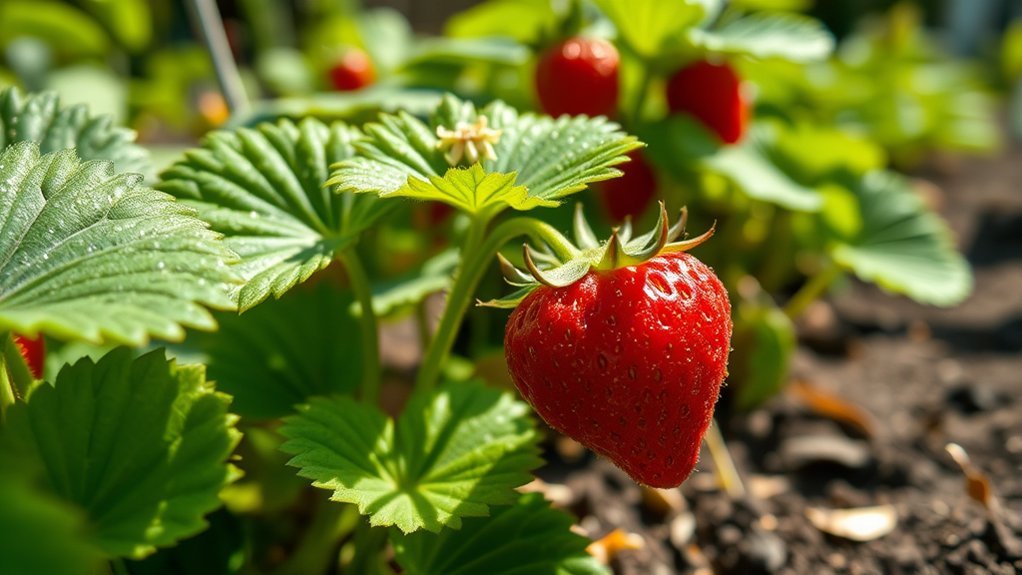
How much light do strawberries actually need to thrive? Strawberries reach photosynthetic saturation between 800-1200 µmol/m²/s PPF, which marks the light levels for ideal growth.
You’ll want to focus on the morning hours, as these critical hours maximize photosynthesis before the rate declines later in the day.
In controlled environments, you can fine-tune light intensity to boost strawberry production, especially during winter conditions when natural light is limited.
CO2 enrichment in closed greenhouses also helps enhance photosynthesis under low light, supporting growth when sunlight isn’t sufficient.
While winter strawberry production requires more research to define exact light needs, managing light levels effectively remains key to ensuring your plants thrive and produce quality fruit year-round.
How to Manage Humidity for Healthy Strawberries?
You’ll want to keep humidity levels above 60% to help your strawberries grow strong and avoid damage like tipburn.
It’s a good idea to use overhead fogging during the day and low-pressure misting at night—these methods work well to maintain those ideal conditions.
Plus, keeping a close eye on humidity means you can catch any problems early and protect both the fruit quality and the overall health of your plants.
Ideal Humidity Levels
Although strawberry plants need plenty of light and nutrients, maintaining ideal humidity levels between 60-80% is essential for their health and fruit quality.
Relative humidity outside this range can cause physiological disorders, reducing fruit quality and hindering growth conditions.
To enhance strawberry production, you should focus on these key points:
- Monitor relative humidity regularly to guarantee it stays within the best humidity levels.
- Use environmental controls to adjust humidity and prevent stress that impacts plant development.
- Prevent dry conditions that lead to tipburn and calyx burn, which damage strawberries.
Fogging And Misting Techniques
Since strawberry plants are highly sensitive to dry conditions, managing humidity through fogging and misting is essential for their health. You can use fogging techniques to maintain humidity levels above 50%, which supports ideal growth and healthy crown development.
The University of Arizona’s method combines daytime high-pressure fogging and nighttime low-pressure misting to boost moisture and reduce stress on the plants. Monitoring environmental conditions and adjusting these systems helps improve fruit development, size, and sugar content.
| Time of Day | Technique | Purpose |
|---|---|---|
| Day | High-pressure fogging | Maintain moisture levels |
| Night | Low-pressure misting | Prevent tipburn & calyx burn |
| Continuous | Humidity monitoring | Adjust fogging/misting |
| All | Moisture control | Support crown development |
| All | Stress reduction | Promote ideal growth |
Preventing Humidity-Related Damage
Three key strategies help you prevent humidity-related damage in strawberry plants: maintaining adequate moisture during the day with high-pressure fogging, boosting nighttime humidity using low-pressure misting, and continuously monitoring humidity levels to avoid issues like tipburn and calyx burn.
Effective humidity management supports healthy growth and reduces stress on the plants.
- Use overhead irrigation with high-pressure fogging to keep daytime humidity ideal.
- Apply low-pressure misting below benches at night to increase moisture and protect fruit quality.
- Continuously monitor humidity levels to promptly adjust your methods and maximize yield.
What Are the Benefits of CO2 Enrichment for Strawberry Growth?
When you enrich CO2 levels in closed greenhouses or high tunnels, strawberry plants can photosynthesize more efficiently, especially during the low light of winter.
CO2 enrichment boosts carbohydrate production, which directly supports better plant health and strawberry growth.
By maintaining CO2 concentrations around 1000-1500 ppm and practicing careful greenhouse management, like keeping vents closed, you maximize photosynthesis and encourage larger fruit size.
This enhanced process results in higher yields and improved fruit quality.
In hydroponic systems, CO2 enrichment is especially valuable, increasing crop productivity and profitability.
Which Strawberry Production System Is Best for Your Farm?
How do you decide which strawberry production system suits your farm best?
You’ll want to take into account your environmental factors and growing conditions first. The matted-row production system works well in northern regions and offers lower initial costs, but managing weed control can be tricky.
In contrast, the plasticulture production system demands higher upfront investment but boosts yield and quality with closer plant spacing and improved picking efficiency.
Focus on these three key points:
- Confirm strawberry planting depth keeps the crown level with soil for healthy growth.
- Choose a system well adapted to your climate—matted-row for cooler areas, plasticulture for warmer zones.
- Practice crop rotation every 5-8 years to maintain soil health and prevent disease buildup.
This approach helps you optimize productivity and sustainability.
How Irrigation Practices Impact Strawberry Yield and Quality?
Choosing the right strawberry production system sets the stage for success, but managing water effectively plays an equally important role in maximizing yield and fruit quality.
Your irrigation practices must provide a steady water supply, especially during fruit development and establishment phases. Consistent watering guarantees ideal soil moisture, preventing water stress that can reduce fruit size and quality.
Drip irrigation delivers 1-2 inches weekly, supporting healthy crown development by maintaining perfect root zone temperatures near 18°C.
While overhead irrigation raises humidity, which benefits plants, excessive moisture risks disease like Gray Mold.
Adjust irrigation based on weather and soil moisture levels to avoid stress during hot periods above 77°F.
How to Manage Nutrients for Optimal Strawberry Growth?
Although strawberries need a well-balanced nutrient supply throughout their growth, you’ll find that their requirements shift with each stage.
Start by conducting soil testing to understand your soil’s macronutrients and micronutrients balance. This helps tailor your fertilizer requirements precisely.
Focus on nutrient timing for the best results:
- Apply ½ lb. of 10-10-10 fertilizer per 100 sq. ft. 2-3 weeks before planting for root development and establishment.
- Increase nitrogen during early growth for lush foliage.
- Boost potassium levels during fruiting to improve fruit quality, flavor, and sugar content.
How to Effectively Control Pests and Diseases in Strawberry Crops?
To protect your strawberry crops from pests and diseases effectively, you need to implement a combination of vigilant monitoring and proactive management strategies.
Start with integrated pest management (IPM) by regularly scouting for pests like Brown Marmorated Stink Bug and Spotted Wing Drosophila.
Choose disease-resistant cultivars to reduce risks from Powdery Mildew and Red Stele. Maintain good air circulation to lower high humidity levels, which favor fungal diseases.
Use preventive fungicides during warm, humid periods to guard against outbreaks.
Practice crop rotation and remove infected plant debris to minimize disease buildup.
By combining these approaches, you’ll control pests and diseases more efficiently, protect your crop’s health, and guarantee better yields.
Staying proactive and attentive is key to managing strawberry pests and diseases successfully.
How Harvesting and Postharvest Handling Affect Strawberry Fruit Quality?
After managing pests and diseases effectively, you’ll want to focus on how harvesting and postharvest handling impact your strawberry fruit quality.
Harvesting strawberries at least three times per week guarantees firm, well-colored, rot-free fruit.
Proper postharvest cooling is essential to remove field heat and extend shelf life, so refrigerate berries immediately to preserve quality.
Cooling strawberries promptly after harvest removes field heat and helps keep them fresh longer.
When picking, leave the calyx and a 1-inch stem to protect the fruit during storage and transport.
Avoid bruising by handling strawberries gently to maintain their marketability.
- Harvest frequently for ideal fruit quality.
- Cool berries quickly to prevent spoilage.
- Handle carefully to minimize bruising during storage and transport.
These steps help you maintain strawberry freshness and maximize marketability.
Frequently Asked Questions
What Is the Best Strawberry Variety for Beginners?
For beginners, Everbearing varieties like ‘Ozark Beauty’ are great because they offer multiple harvests and have flexible growth habits.
Day neutral options such as ‘Seascape’ provide continuous fruiting, making harvesting easier.
June bearing types deliver a big crop but need more attention.
Choose varieties with good disease resistance and climate suitability to simplify care.
Also, consider flavor profiles you enjoy to make growing strawberries even more rewarding.
How Often Should Strawberries Be Watered During Flowering?
Picture soil gently soaking up water like a sponge during the flowering stage. You should water your strawberries to keep soil moisture steady, aiming for 1-2 inches weekly.
Adjust watering frequency based on climate impact. Water more often during dry spells.
Use drip irrigation to target roots directly, preserving root health and preventing disease.
Consistent watering during flowering boosts yield improvement, ensuring vibrant blooms and juicy fruit.
Can Strawberries Be Grown Indoors or in Containers?
Yes, you can grow strawberries indoors using container gardening. Focus on container requirements like proper drainage and size.
Select well-draining soil with the right pH, and guarantee consistent watering techniques to keep roots moist.
Provide ample light exposure, about 8 hours daily, or use supplemental grow lights. Maintain temperature control around 60-75°F, manage pests carefully, and harvest fruit when fully red.
Indoor gardening lets you enjoy fresh strawberries year-round with proper care.
What Are Common Signs of Nutrient Deficiencies in Strawberries?
When it comes to nutrient imbalance signs in strawberries, you’ll often see yellow leaf symptoms and stunted growth indicators as the first red flags.
Leaf discoloration causes like magnesium or iron deficiencies make your leaves look patchy or pale.
Poor fruit development and blossom drop reasons often tie back to root rot signs or soil pH effects messing with nutrient uptake.
Catch these early, or your harvest will be a tough nut to crack!
How Long Does It Take for Strawberries to Start Fruiting?
Strawberries typically start fruiting 4-8 weeks after planting, depending on the variety and strawberry growth stages.
You’ll want to focus on soil quality, climate considerations, and sunlight requirements to speed this up.
Proper planting techniques, pest management, and fertilization schedules also play big roles.
Environmental impacts like temperature and light availability affect timing, so adjusting care based on your conditions helps you get those sweet berries sooner.
Conclusion
Growing strawberries is like tending a delicate dance. You need the right soil, balanced nutrients, proper light, and consistent water to keep everything in sync.
When you carefully manage temperature, pests, and harvesting, you set the stage for juicy, flavorful berries. By paying attention to these factors, you’ll help your strawberry plants perform their best.
This will reward you with a bountiful, delicious harvest that makes all your effort truly worth it.