

Why Are Strawberries Called Strawberries
You call them strawberries because their plants spread by runners that scatter fruit, matching the Old English “streawberige,” meaning to spread or scatter. Farmers used straw mulch to keep berries clean and moist, reinforcing the name.
The tiny seeds, or achenes, scattered on the surface also contributed to the term. Origin tales and cultivation history reveal more fascinating connections, including a French explorer’s role and how these berries traveled from the New World to Europe.
Earliest Written Uses of “Strawberry
The earliest written mentions of strawberries reveal how people valued them more for medicine than food. You’ll find that the earliest known literary description dates back to around 1000 AD, focusing mainly on the medicinal properties of strawberry plants rather than their taste.
Even earlier, Roman Senator Cato, between 234-149 BC, highlighted their healing benefits in his writings.
When you explore the 12th century, Saint Hildegard Von Binger went as far as to say strawberries weren’t fit to eat, showing how perceptions varied widely.
By 1484, the first printed sketch of strawberries appeared, marking their growing recognition in both art and literature.
These early records emphasize strawberry plants as valuable for health long before they became popular as food.
The Role of Plant Growth Habit in Naming Strawberries
You’ll notice that strawberry plants spread out by sending runners, creating a scattered look.
This growth habit actually inspired the Old English name “streawberige,” which means to spread or scatter.
Spreading Growth Pattern
If you look closely at strawberry plants, you’ll notice how they spread by sending out runners called stolons that take root and grow new plants. This spreading growth pattern gives the plants a scattered, connected look, which likely inspired their name.
The Old English word “streawberige” hints at this habit, meaning “to spread or scatter.” Here’s a simple breakdown:
| Feature | Description | Impact on Name |
|---|---|---|
| Stolons | Runners that root new plants | Creates spread |
| Growth Habit | Spreading, connected plants | Scattered appearance |
| Seed Arrangement | Seeds scattered on fruit | Reinforces spread |
| Propagation Method | Vegetative reproduction | Promotes spread |
| Appearance | Plants and seeds scattered | Influences naming |
Understanding this helps you see why strawberry plants earned their name through their unique spreading growth pattern.
Origin Of Name
Although many believe strawberries got their name from the straw used to mulch the plants, the way these berries grow plays a significant role too.
The name strawberry actually traces back to the Old English word “streawberige,” which means “to spread or scatter.” This perfectly describes how strawberry plants propagate by sending out stolons that scatter new plants around.
You can see how this growth habit influenced the name strawberry, reflecting the plant’s natural tendency to spread across the ground.
Beyond mulching or the fruit’s surface resembling straw, the plant’s spreading nature shaped the term.
The Role of Straw Mulching in the Strawberry Name
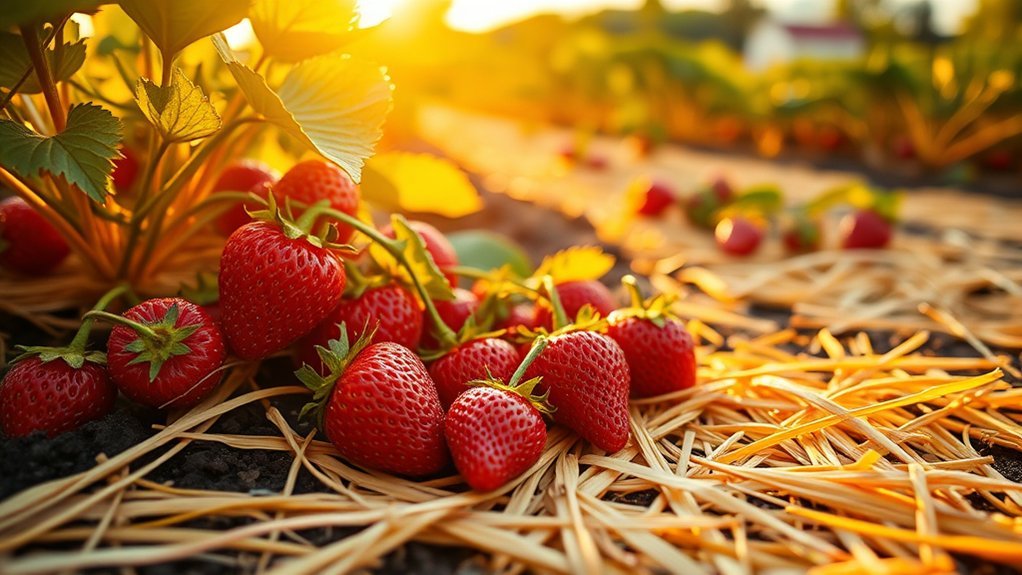
You’ve probably noticed gardeners using straw to mulch their strawberry plants, and it’s not just for decoration.
Straw mulch actually helps keep the berries clean, controls weeds, and holds in moisture, which all work together to help the fruit grow better.
When you think about how this practice played a part in the name “strawberry,” it shows there’s a practical reason behind it.
Straw Mulching Benefits
Because straw mulching plays an essential role in strawberry cultivation, it has influenced the fruit’s very name. When you use straw mulching, you protect the soil and plants, which boosts strawberry production.
Mulching keeps the fruit clean, prevents weeds, and balances soil temperature, helping your strawberries thrive. Plus, it supports beneficial insects that naturally control pests.
Here’s a quick look at straw mulching benefits:
| Benefit | Impact on Strawberries |
|---|---|
| Moisture retention | Keeps soil consistently damp |
| Weed suppression | Reduces competition for nutrients |
| Fruit cleanliness | Prevents soil splashes and rot |
| Temperature regulation | Protects from extreme weather |
| Pest control | Encourages beneficial insects |
Using straw mulching, you create ideal growing conditions that directly enhance strawberry production.
Straw Usage Origins
Straw mulching does more than improve strawberry growth. It also plays a key role in how the fruit got its name.
When you tend strawberry cultivars, you’ll notice straw helps in several ways that influenced naming:
- Straw mulching protects the fruit from soil contact, keeping berries clean.
- It retains soil moisture, promoting healthier plant growth.
- Straw reduces rot by improving air circulation around the berries.
- The visible straw around plants led early farmers to associate the fruit with its protective layer.
While some think the name comes from the seed’s straw-like appearance, the practical use of straw in cultivation is a strong origin story.
Mulch And Berry Growth
Mulch layers have played an essential role in strawberry cultivation, directly impacting both berry quality and the fruit’s name. When strawberry plants are mulched with straw, the berries stay clean and avoid soil contact, which reduces rot and spoilage.
This practical use of straw helped shape the name “strawberry” and improved your harvest’s appearance and taste. Kids also sold “Straws of Berries,” tying straw to the fruit’s identity.
Here’s how mulching affects berries:
| Benefit | Emotion Evoked |
|---|---|
| Keeps berries clean | Satisfaction |
| Prevents rot | Relief |
| Enhances growth | Hope |
| Maintains moisture | Comfort |
| Reduces spoilage | Confidence |
Where Did We Get the Word “Strawberry”?
Have you ever wondered how the word “strawberry” came about? The name has fascinating ties to both the fruit and the word “straw.” Here’s where it likely comes from:
Farmers used straw to mulch strawberry plants, keeping berries clean and moist.
The Old English word “streawberige” means “to spread or scatter,” reflecting how strawberry plants grow.
The term “strawberry” has appeared in literature since the 10th century, showing its deep historical roots.
The connection to “straw” highlights how cultivation methods influenced the berry’s name.
How the Berry’s Scattered Achenes Inspired the Name
You’ve probably noticed those tiny seeds dotting a strawberry’s surface, right? They’re called achenes, and they’re actually pretty important when it comes to the berry’s name.
The Old English word “streawberige” gives us a clue—it’s all about spreading or scattering. And that’s exactly how these little achenes look, scattered all over the fruit.
Once you get that connection, it’s easy to see how the berry’s unique look inspired its name.
Achenes And Appearance
The tiny achenes scattered across a strawberry’s surface catch your eye and hint at the fruit’s unique structure.
These small achenes, often mistaken for seeds, actually shape the strawberry’s distinctive appearance. Here’s why they matter:
- Achenes are individual fruits, not true seeds, dotting the strawberry’s exterior.
- Their scattered pattern inspired the name “strawberry,” linking to the idea of something strewn or spread out.
- This appearance sets strawberries apart from other fruits, making them instantly recognizable.
- The visible achenes emphasize the berry’s complex structure, reflecting both its biology and etymology.
Linguistic Origins Explained
Although many believe “strawberry” comes from the practice of mulching with straw, the fruit’s name more likely traces back to the scattered achenes on its surface.
The Old English term “streawberige,” meaning “to spread or scatter,” reflects this perfectly.
When the strawberry was first named, people noticed how the tiny seeds, or achenes, appeared strewn across the berry, much like something scattered by hand.
This visual of achenes inspired the linguistic roots of the name of Fragaria, the botanical genus for strawberries.
The growth habit of the plant, spreading through stolons, also ties into this idea of scattering, reinforcing why the name strawberry was first used based on this characteristic rather than the straw mulch method.
You can see how language connects closely with nature here.
Selling “Strays of Berries” in Historical Markets
When you stroll through historical London markets around 1831, you’d notice children selling strawberries strung on pieces of straw. This practice helped the fruit earn its familiar name. This unique selling method, called “Strays of Berries,” connected the fruit to its presentation.
Here’s what you’d observe:
- Children used straw to string strawberries, making them easy to carry and sell.
- Straw also mulched the berries, keeping them clean and fresh.
- The term “streawberige” from Old English means “to spread or scatter,” reflecting how strawberry plants grow.
- This method highlighted strawberries’ popularity and cultural significance in markets.
Indigenous Names and Cultural Meanings of Strawberries
If you explore indigenous cultures, you’ll find strawberries carry deep meanings beyond their sweet taste. For example, the Narragansett Indians called strawberries “wuttahimneash,” meaning “heart berry,” highlighting both the fruit’s heart shape and its cultural significance.
This indigenous name reflects the respect and symbolism strawberries held in their traditions.
You’ll also discover that indigenous peoples cultivated the Chilean strawberry, Fragaria chiloensis, for nearly a millennium, showing how important the fruit was in their agriculture and daily life.
These indigenous names and cultural significance offer a richer understanding of strawberries, connecting you to the fruit’s history beyond just its English name, which relates more to farming methods than to these ancient, meaningful roots.
What’s Behind the Strawberry’s Scientific Name?
The scientific name Fragaria x ananassa reveals much about the strawberry’s origins and qualities.
When you break it down, you’ll see why it’s so fitting:
- Fragaria comes from the Latin “fragra,” meaning fragrant, highlighting the berry’s sweet aroma.
- The “x” shows this is a hybrid, not a pure species of strawberry.
- Ananassa hints at its pineapple-like flavor, which is why it’s sometimes called the pineapple strawberry.
- This hybrid resulted from crossing two species of strawberry: Fragaria chiloensis and Fragaria virginiana.
Developed in the 18th century, Fragaria x ananassa quickly spread across continents, becoming the most popular species of strawberry you enjoy today.
Understanding its scientific name connects you to its rich botanical heritage.
French Explorer Frézier’s Role in Strawberry History
Although you might not realize it, French engineer Amédée-François Frézier played an essential role in shaping the strawberries you enjoy today by introducing the Chilean strawberry, Fragaria chiloensis, to Europe in 1712. He discovered this larger strawberry with whitish-red fruit and thicker leaves during a mission in Chile.
By crossing the Chilean strawberry with Fragaria virginiana, Frézier created the hybrid Fragaria x ananassa, which boosted strawberry size and flavor. This hybrid quickly spread across Europe and the Americas, transforming strawberry cultivation.
| Explorer | Strawberry Type | Key Contribution |
|---|---|---|
| Amédée-François Frézier | Chilean strawberry | Discovered and introduced to Europe |
| Fragaria chiloensis | Chilean strawberry | Larger fruit, thicker leaves |
| Fragaria virginiana | North American strawberry | Crossbred with Chilean strawberry |
| Fragaria x ananassa | Hybrid strawberry | Enhanced size and flavor |
| Europe & Americas | Cultivation regions | Adopted hybrid for farming |
The Journey of New World Strawberries to Europe
When you trace the path of strawberries to Europe, you’ll find that French engineer Amédée-François Frézier played an essential role by bringing the Chilean Fragaria chiloensis back from his 1712 mission.
This larger fruit soon transformed strawberry cultivation. Here’s how:
- Frézier discovered the Chilean strawberries, noted for their size and unique whitish-red color.
- He observed native cultivation methods, including planting in fields with thicker, rounder leaves.
- After returning to France, he crossed Fragaria chiloensis with the North American Fragaria virginiana.
- This hybrid, Fragaria x ananassa, had better flavor and size, sparking widespread commercial production.
Thanks to this journey, you now enjoy strawberries that are bigger, tastier, and widely available, revolutionizing European agriculture forever.
Why Strawberries Are Linked to “Pineapple” in Naming
Because botanist Amédée-François Frézier crossed two strawberry species, you’ll often hear the hybrid Fragaria x ananassa called the pineapple-strawberry due to its unique flavor resembling pineapple.
Frézier combined the Chilean strawberry with Fragaria virginiana, a North American species, to create this distinct hybrid.
This new variety quickly gained popularity across Europe, thanks to its invigorating taste and versatility.
The pineapple-strawberry’s name highlights this flavor similarity while honoring its botanical roots.
When you taste it, you’ll notice hints that set it apart from other strawberries, making the name fitting.
Understanding this link helps you appreciate how strawberry naming reflects both scientific discovery and flavor perception, especially in European gardening and culinary traditions.
How the Name “Strawberry” Reflects Its Cultural Impact
While the exact origin of the name “strawberry” remains debated, its cultural impact is clear in how people have connected the fruit to everyday life.
You can see this influence in several ways:
- Children in London once sold strawberries strung on straw, blending commerce with tradition.
- The Old English root “streawberige” shows how the plant’s spreading habit mirrored cultural language.
- Mulching with straw to protect strawberries linked agricultural practice directly to the name.
- The French botanist Frézier, whose name comes from “fraise” (strawberry), highlights the fruit’s role in scientific and cultural history.
Frequently Asked Questions
Are Strawberries Technically Berries or Another Fruit Type?
Strawberries aren’t technically berries according to botanical classification.
You see, true berries develop from a single ovary, but strawberries form from the flower’s receptacle, which is the thickened stem part.
In fruit terminology, those tiny “seeds” on their surface are actually the true fruits, called achenes.
How Do Strawberries Grow Compared to Other Fruits?
You might think strawberries grow on magical vines, but strawberry cultivation is actually pretty unique!
Unlike most fruits that pop directly from flowers, strawberries grow from a crown sending out runners to make baby plants.
Compared to other fruit crops, this method is like a strawberry army spreading out, while apples and oranges stick to their tree branches.
This clever fruit comparison shows how strawberries conquer gardens with style and efficiency!
What Are the Health Benefits of Eating Strawberries?
You’ll benefit from strawberries’ impressive nutritional value, as they’re packed with vitamin C, fiber, folic acid, and potassium.
Their antioxidant properties help reduce inflammation and protect your body from chronic diseases.
Eating strawberries regularly can boost your immune system, improve heart health, and promote healthy skin.
Plus, they’re a low-calorie snack, so you can enjoy their sweet taste while supporting your overall wellness without worrying about extra calories.
Why Do Strawberries Turn Red When Ripe?
You might think strawberries turn red just to flaunt their fashion sense, but nope, it’s all about the ripening process.
During this color change, anthocyanins ramp up while chlorophyll takes a backseat, making the berry blush a vibrant red.
This isn’t vanity. It’s nature’s clever signal, telling you and hungry critters, “Hey, I’m sweet and ready!”
How Can You Tell if a Strawberry Is Fresh?
You can tell if a strawberry is fresh by looking for fresh signs like vibrant red color and firm, plump texture.
The green leaves at the top should be bright and not wilted.
During peak season, strawberries usually smell sweet and have no mold or bruises.
If you spot these signs, you’re picking a fresh, flavorful berry ready to enjoy right away.
Conclusion
So, you’d think something as sweet and simple as a strawberry would have an obvious name, right? But nope. You’ve got mulching straw, scattered seeds, and even French explorers all tangled up in the story.
It’s ironic that a fruit so familiar is named with such mystery and mix-ups. Next time you bite into one, remember: the strawberry’s name is as unexpectedly complex as its flavor is delicious. Who knew?