
Which State Produces the Most Strawberries?
If you’re wondering which state produces the most strawberries, it’s California by far. In 2024, California is expected to grow over 91% of all U.S. strawberries, thanks to its ideal climate and diverse growing regions.
With yields reaching up to 68,000 pounds per acre, the state leads the nation’s strawberry market by a wide margin. Florida comes in second, but California’s dominance is clear.
Keep exploring and you’ll find out what makes California’s production so unique.
Which State Leads U.S. Strawberry Production in 2024?
Wondering which state tops the list for strawberry production in 2024? It’s California Strawberry, hands down.
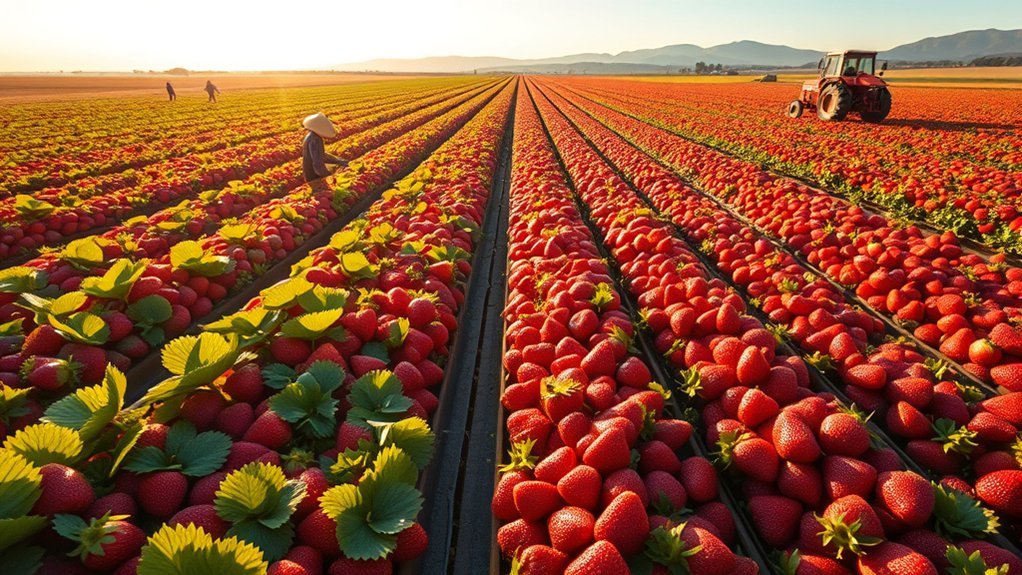
You’ll find that California is projected to produce about 29 million hundredweight (CWT) of strawberries this year, which covers over 91% of all U.S. strawberries grown.
This isn’t a sudden spike; California’s production has steadily climbed from around 15.7 million CWT in 2000 to the current forecast.
The secret lies in California’s ideal climate and geographic conditions, especially along its coastlines and valleys, which create the perfect environment for strawberry farming.
When you pick up a strawberry, chances are it came from California, making it the undisputed leader in the U.S. strawberry market for 2024.
Overview of U.S. Strawberry Production and Top States
Although California dominates U.S. strawberry production with over 91% of the total output, other states like Florida also play an essential role, especially during winter months.
California’s projected output hits 29 million hundredweight (CWT) in 2025, reflecting massive growth since 2000. You’ll see that this state alone produced around 2.46 billion pounds of strawberries in 2021, valued at nearly $3 billion.
Meanwhile, Florida ranks second with a projected 3.32 million CWT in 2025, primarily supplying strawberries when California’s harvest slows down. Their production has steadily increased since 2000, highlighting its importance as a winter crop producer.
Together, these states drive the U.S. strawberry production industry, ensuring fresh berries year-round for consumers like you.
How California’s Climate Boosts Strawberry Output
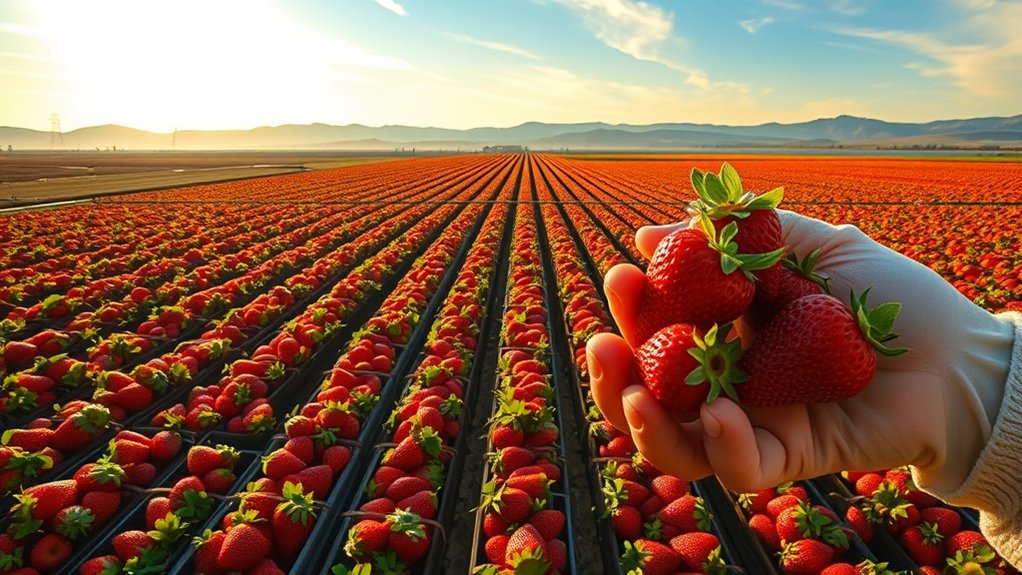
Because California enjoys a temperate climate, it supports a year-round strawberry growing season that few other states can match. This consistent weather lets you harvest fresh strawberries throughout the year, boosting California’s output substantially.
California’s temperate climate enables year-round strawberry harvesting, making its output unmatched nationwide.
The state’s coastal and valley regions offer ideal temperatures and sunlight, which are essential for producing large yields and top-quality fruit.
Here’s how California’s climate helps strawberry production:
- Enables a 12-month growing season
- Provides favorable temperatures and abundant sunlight
- Supports average yields of up to 68,000 pounds per acre
- Creates diverse microclimates from San Diego to Santa Maria
- Accounts for over 91% of strawberries consumed in the U.S.
Thanks to these climate advantages, California firmly leads as the nation’s strawberry powerhouse.
Key California Regions Driving Strawberry Production
You’ll find California’s strawberry success centers around its coastal growing areas like Oxnard-Ventura, Santa Maria, and Watsonville-Salinas.
These regions benefit from ideal climates that support year-round production.
And as demand grows, production zones are expanding to keep up with the market.
Coastal Growing Areas
When you explore California’s strawberry production, the coastal regions stand out as key contributors.
These coastal growing areas offer ideal climates that maximize strawberry yield and quality, making California the top U.S. producer with over 91% of the national output.
Here’s what makes these coastal growing areas so essential:
Oxnard-Ventura benefits from a temperate climate, enabling year-round cultivation.
Santa Maria’s favorable weather boosts both yield and fruit quality.
Watsonville-Salinas features geographic diversity that extends the growing season.
Coastal temperatures and sunlight optimize plant growth and fruit development.
Average yields can reach up to 68,000 pounds per acre, reflecting the region’s productivity.
You’ll find these areas are the backbone of California’s strawberry dominance, thanks to their unique coastal advantages.
Expanding Production Zones
As California’s strawberry demand grows, producers are expanding beyond traditional coastal hubs to new regions across the state.
While areas like Oxnard-Ventura, Santa Maria, and Watsonville-Salinas remain key, you’ll now find strawberry fields stretching from San Diego up through Orange County.
This geographic diversity in California allows for an extended growing season, giving you fresh strawberries year-round.
Thanks to California’s temperate climate, you can expect high yields, up to 68,000 pounds per acre, far surpassing other states.
Production has nearly doubled since 2000 and is projected to hit 29 million hundredweight in 2025.
Florida’s Role as the Second Largest U.S. Strawberry Producer
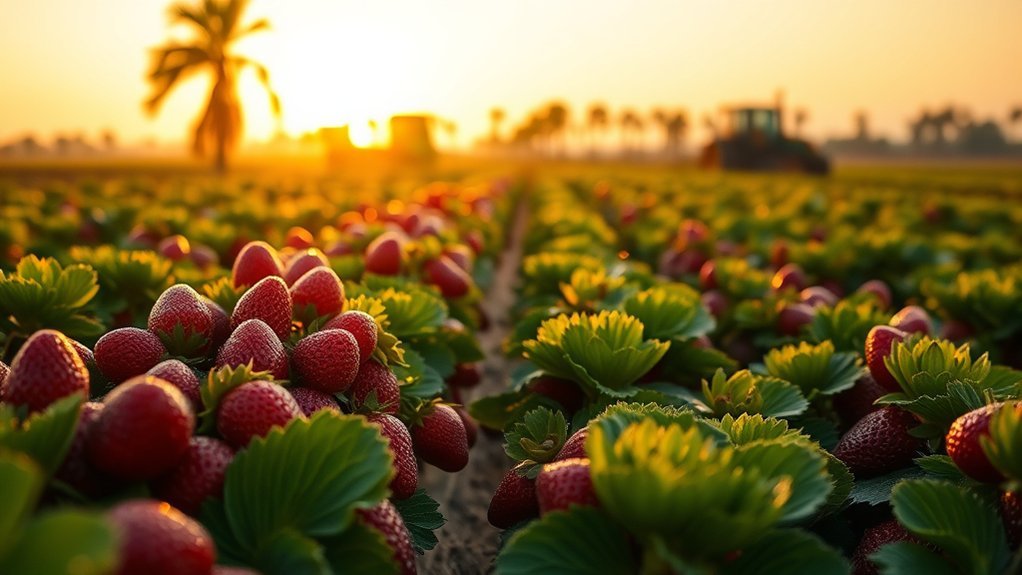
Florida holds an essential spot as the second-largest strawberry producer in the United States, with a steady projected output of 3,320,000 hundredweight for both 2024 and 2025.
You’ll find Florida’s strawberry production stable and growing, having increased from 2,205,000 CWT in 2000 to nearly 3 million CWT in 2023. The state’s winter season lets you enjoy fresh strawberries when other regions produce less.
Key points about Florida’s strawberries:
- Consistent production projected for 2024 and 2025
- Winter harvest season complements national supply
- Production rose from 2,820,000 CWT in 2022 to 2,960,000 CWT in 2023
- Steady growth reflects sustainable farming practices
- Vital role in year-round U.S. strawberry availability
Why California Produces Over 90% of U.S. Strawberries
Because California’s temperate climate supports a year-round growing season, it produces over 91% of the nation’s strawberries, with a projected output of 29 million hundredweight in 2025. You can thank California’s diverse geography, like San Diego, Oxnard-Ventura, and Santa Maria, for extending the growing season and boosting yields.
In fact, strawberry production there can reach up to 68,000 pounds per acre, far surpassing other states. Over time, California’s output has nearly doubled since 2000, highlighting steady growth in the industry.
With strawberries generating nearly $3 billion in value, California isn’t just the top producer; it’s the economic powerhouse of U.S. strawberry farming.
When you pick up fresh strawberries, there’s a good chance they came from California’s fertile fields.
How Seasons Affect Strawberry Production by State
When you look at strawberry production across the U.S., seasonal differences play a huge role in how much fruit each state can grow.
California’s nearly year-round growing season lets you harvest strawberries almost any month, boosting its output to 29 million CWT in 2025. In contrast, Florida’s shorter growing season focuses on winter months, producing around 3.3 million CWT. Other states face even shorter seasons, limiting their yields.
California’s 12-month growing season maximizes harvest opportunities. Florida’s winter-only season restricts production to a few months.
Soil and climate dictate how long and when strawberries grow. Geographic diversity in California allows staggered picking times. Shorter growing seasons elsewhere mean lower total yields.
Your state’s season length directly impacts how many strawberries you can grow.
How Farming Practices Influence Strawberry Yields and Quality
You’ll notice that the way strawberries are grown—whether using the hill system or matted rows—directly affects both yield and fruit quality.
It’s pretty interesting how these methods change things up. Climate also plays a huge role. For example, temperate conditions really help the plants thrive all year round.
And don’t forget about soil health and fertility; managing those well ensures your crop stays strong and productive throughout the season.
Cultivation Systems Impact
Although strawberry cultivation involves various methods, the choice between the hill system and the matted row system plays a crucial role in determining both yield and fruit quality.
You’ll find that cultivation systems directly influence how runners grow and how you manage the plants.
The hill system removes runners, focusing energy on fruit, often resulting in larger berries. In contrast, the matted row system allows runners to spread, creating denser plants but sometimes reducing individual fruit size.
Other factors tied to cultivation systems include selecting strawberry varieties suited for each system and managing soil fertility to maintain ideal pH (5.5 to 6.5).
Using high tunnels to extend growing seasons also helps.
You’ll want to balance plant density for yield and quality and adjust irrigation and nutrient delivery based on the system you choose.
Choosing the right cultivation system helps you maximize both yield and strawberry quality.
Climate Effects On Yield
Because California’s temperate climate supports a year-round growing season, farmers there can achieve much higher strawberry yields than in states with shorter seasons.
When you grow strawberries in the United States, you’ll notice that California’s climate effects on yield are significant.
In 2017, California’s average yield reached 50,500 pounds per acre, vastly outpacing states limited by colder or shorter seasons, where yields could be as low as 3,200 pounds.
You can also use high tunnel production to extend the season and boost both the quantity and quality of your strawberries.
Selecting the right farming method, like the matted row system, works best in this climate to maximize runner spread and fruit production.
Soil And Fertility
When you manage soil and fertility well, you set the foundation for healthier strawberry plants and bigger harvests.
Strawberries in the United States thrive best in slightly acidic soils with a pH between 5.5 and 6.5.
Proper nitrogen fertilization each year supports growth, runner development, and fruit formation. The cultivation system you choose, whether hill or matted row, also affects yield and quality.
Keep in mind, planting strawberries after solanaceous crops can raise disease risks like Verticillium wilt.
California’s superior soil management and nutrient balance help it achieve yields up to 68,000 pounds per acre, outpacing other states.
- Maintain soil pH at 5.5–6.5 for ideal nutrient uptake
- Apply nitrogen fertilizers annually for robust growth
- Choose cultivation systems based on yield goals
- Avoid planting after disease-prone crops
- Adjust nutrient management to soil type and climate
Major Challenges Facing U.S. Strawberry Growers
If you’re curious about what makes strawberry farming tough in the U.S., you’ll find that growers face a mix of challenges from labor shortages to unpredictable weather.
The production of strawberries relies heavily on seasonal labor, and shortages drive up harvesting costs and reduce efficiency, especially in top-producing states like California.
Climate variability, including droughts and extreme weather, threatens yields during the 12-month growing season there.
You also have to manage pests and diseases carefully, as pathogens like E. coli and Norovirus demand strict, costly food safety practices.
Rising input costs for water, fertilizers, and labor squeeze profits further.
Plus, competition from cheaper imported strawberries pressures you to maintain market share despite these hurdles, making strawberry farming a demanding and complex business.
Economic Impact of Strawberry Production in Leading States
The economic impact of strawberry production in leading states like California and Florida plays an essential role in shaping local agricultural economies.
Strawberry production is vital in driving economic growth and supporting agricultural communities in California and Florida.
You’ll find California dominates with over 91% of U.S. strawberries, generating nearly $3 billion annually. Florida, while smaller, adds diversity and economic stability. Strawberry production boosts local job markets and supports farming communities beyond just the fields.
Key economic impacts include:
California’s 2025 projected production: 29 million CWT
Florida’s 2025 output: 3.32 million CWT
Average grower price: $143 per hundredweight (2021)
Employment opportunities tied to strawberry farms
Community engagement driven by agricultural activities
Understanding this economic impact shows how significant strawberry production is for these states’ economies and local livelihoods.
How California Extends Its Strawberry Growing Season
Because of its temperate climate and diverse geography, California lets growers produce strawberries nearly year-round. You’ll find coastal and valley regions like Oxnard-Ventura and Santa Maria providing perfect conditions: sunlight, temperature, and soil quality to keep berries growing.
California farmers also use high tunnel production to shield crops from pests and weather, further stretching the harvest season. Plus, staggered planting from San Diego to Orange County means fresh strawberries are always available.
| Region | Climate Benefit | Emotional Impact |
|---|---|---|
| Oxnard-Ventura | Mild temperatures | Hope for fresh picks |
| Santa Maria | Ample sunlight | Joy in every bite |
| San Diego Area | Diverse microclimates | Comfort in abundance |
Emerging Trends in U.S. Strawberry Production
While California continues to dominate U.S. strawberry production with over 91% of the market, you’ll notice emerging trends reshaping the industry nationwide. Florida is carving out its niche in winter strawberries, and innovative techniques are changing how strawberries are grown and sold.
California leads U.S. strawberry production, while Florida innovates with winter crops and new growing techniques.
You’ll see farmers adopting new methods to boost yields and engage consumers directly.
Here are key trends to watch:
- Expansion of U-pick operations, letting you pick your own strawberries and helping farmers cut labor costs
- Use of high tunnel production systems to extend growing seasons and improve fruit quality
- Increased focus on sustainable and organic practices
- Development of disease-resistant strawberry varieties
- Greater investment in technology for precision agriculture and yield monitoring
These trends are transforming how and where strawberries thrive in the U.S.
Frequently Asked Questions
What Are the Health Benefits of Eating Strawberries?
When you eat strawberries, you boost your vitamin C intake, supporting your immune system and skin health.
They’re packed with antioxidants that help reduce inflammation and protect your heart.
Their fiber keeps your digestion smooth and helps you feel full, aiding weight management.
Potassium in strawberries regulates your blood pressure.
Try incorporating strawberry recipes into your meals to enjoy these benefits deliciously and easily every day.
How Do Strawberries Compare Nutritionally to Other Fruits?
Strawberries stand out with their stellar nutritional comparison. You’ll find they’re low in calories yet loaded with luscious fiber and lively vitamin C, more than many fruits offer.
Their antioxidant arsenal, especially flavonoids, fights free radicals fiercely.
So, when you snack on strawberries, you’re choosing a sweet, satisfying superfruit that supports your health better than many other fruits.
Their vibrant nutrients make them a top-tier tasty treat for your diet.
What Is the Best Way to Store Fresh Strawberries?
The best way to store fresh strawberries is by using proper storage techniques. You should cool them within an hour after picking and keep them unwashed in a breathable container to prevent moisture buildup.
Store strawberries at 0 °C (32 °F) with 90-95% humidity. Avoid stacking them too high to prevent bruising.
Check daily for mold or spoilage, removing affected berries to keep the rest fresh longer.
Are There Organic Strawberry Farms in the Top-Producing States?
Yes, you’ll find organic farms in the top-producing states.
California, for example, has a solid presence of organic strawberry farms, with about 10% of its acreage dedicated to organic production.
These farms meet strict standards certified by organizations like the California Certified Organic Farmers.
Florida also grows organic strawberries, especially in central regions.
If you’re after sustainably grown strawberries, these organic farms provide plenty of options to choose from.
How Can Consumers Tell if Strawberries Are Locally Grown?
You can tell if strawberries are locally grown by checking labels or signage that highlight local sourcing at farmers’ markets or grocery stores.
Look for packaging info or ask store staff about the origin.
Seasonal availability also helps. Fresh strawberries in late spring to early summer are often local.
Visiting U-pick farms lets you harvest berries yourself, ensuring local sourcing directly from the farm.
These steps help you support local growers confidently.
Conclusion
If you’ve ever bitten into a juicy strawberry, you can thank California, the undisputed king of U.S. strawberry production. With its perfect climate and extended growing season, California outshines other states like a bright red jewel in the agricultural crown.
While Florida plays a strong supporting role, California’s strawberry fields are the heart beating behind America’s berry supply. Next time you enjoy that sweet taste, remember the dedication fueling this delicious harvest.