

What Size Container for Strawberries?
You’ll want a container that’s at least 5 gallons, but ideally 7 gallons, to give your strawberry plants enough room for healthy root growth and bigger fruit. Choose pots about 12 inches deep and wide if round, or 24 inches long if narrow, to avoid cramped roots.
This size also helps with moisture retention and airflow, reducing watering frequency and disease risks. Keep going to discover how container shape and care can boost your harvest.
Why Container Size Matters for Root Health and Fruit Yield
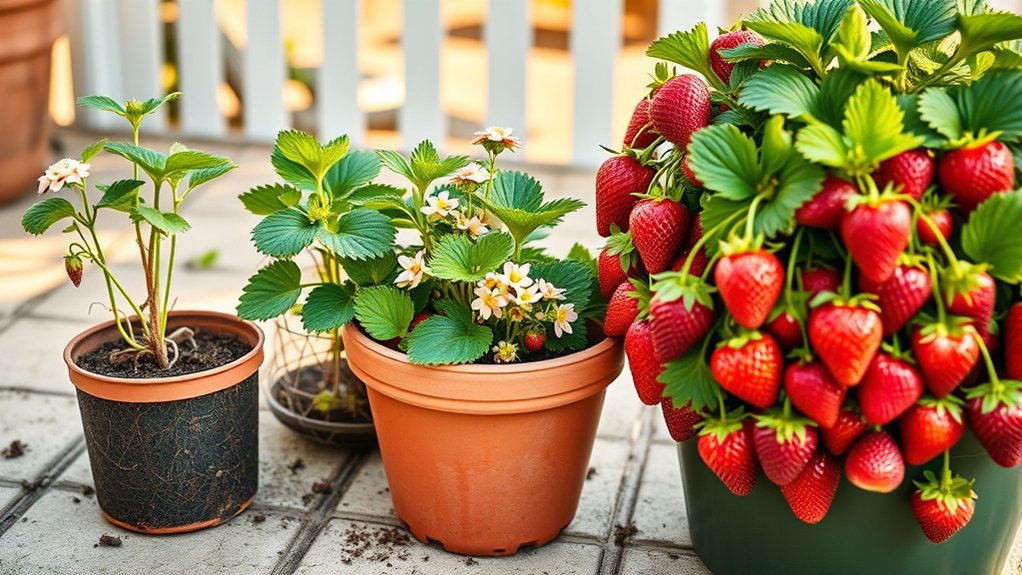
Because strawberry roots can grow up to 6 inches deep and 12 inches wide, choosing a container at least 5 gallons in size with a depth of 10-12 inches is essential for healthy root development and strong fruit yield.
If you go smaller, roots can become cramped, stunting growth and reducing fruit production.
Opting for a 7-gallon pot gives your strawberries even more room to spread out, encouraging bigger fruits and better overall health.
Choosing a 7-gallon pot allows strawberries ample space for growth and improved fruit quality.
Remember, overcrowding plants in a container limits root space and can harm their vigor.
Also, container size isn’t just about volume; the shape matters too.
Long, narrow containers improve soil aeration and drainage, boosting root health and fruit yield compared to round pots.
Minimum Container Dimensions for Healthy Strawberry Roots
To give your strawberry roots enough room to grow, you’ll want a round container with a minimum diameter of 12 inches. This size guarantees your plants have enough space for root expansion, as strawberry roots typically grow about 6 inches deep and 12 inches wide.
If you prefer rectangular containers, aim for a length of at least 24 inches to accommodate multiple strawberry plants comfortably. Containers holding at least 5 gallons work best, supporting 3-4 plants per square foot without overcrowding.
Going larger, such as 7-gallon containers, further promotes healthy root development and better fruit size by allowing more nutrient absorption.
Choosing containers with these minimum dimensions helps guarantee your strawberries thrive and produce abundant fruit.
Container Shape: Round Pots vs. Long Narrow Containers
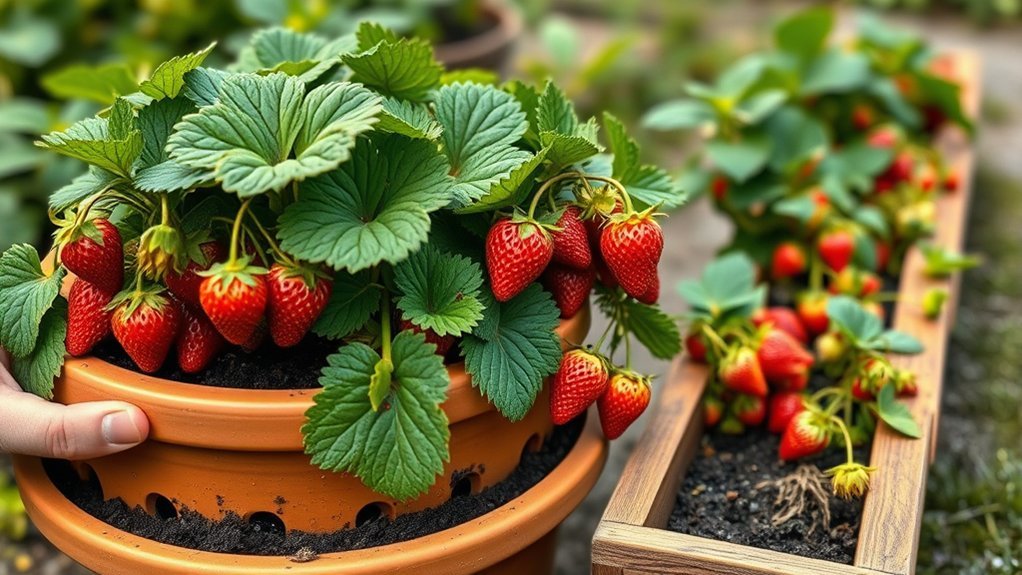
How do you decide between round pots and long narrow containers for your strawberries? In container gardening, the shape you choose impacts root spread and yield.
Round pots should be at least 12 inches in diameter to give your plants enough space to grow.
However, long narrow containers, ideally 24 inches or longer, often produce heavier yields because their shape lets roots spread out more easily and access nutrients better.
Plus, long containers typically use less soil while maximizing productivity.
Remember, the material and drainage quality of your container are just as important as its shape.
Choosing the right container shape helps you grow healthier, more productive strawberry plants in your container garden.
Container Depth Impact on Strawberry Plant Growth
You’ll want a container that’s at least 10 to 12 inches deep to give your strawberry roots enough room to grow properly.
When roots have enough space, your plants can absorb moisture and nutrients more efficiently. This really helps produce bigger, juicier fruit.
If you skimp on depth, it can stunt growth and shrink your harvest.
Optimal Root Depth
Many strawberry plants thrive best when their roots have at least 6 to 12 inches of soil to grow in. This range represents the ideal root depth, ensuring your plants develop strong, healthy roots similar to those growing in the ground.
If you use shallow containers, you’ll restrict root expansion, which limits nutrient uptake and stunts growth. For most varieties, a container depth of around 10 to 12 inches works best, providing enough room for roots to spread while maintaining proper drainage.
Choosing deeper pots, like 7-gallon containers, supports robust root systems, enhances plant health, and boosts resilience to drought.
Effects On Fruit Size
Since strawberry roots need enough space to grow deeply and spread wide, the size of your container directly influences the fruit your plants produce.
Choosing the right container depth helps your strawberries thrive and boosts fruit size. Here’s how container depth impacts your harvest:
At least 6 inches deep is necessary for adequate root growth. Ideal containers measure 10 to 12 inches deep to accommodate root spread.
Shallow containers stunt root development, leading to smaller fruit. Proper depth can increase fruit size by 20-30%.
Larger containers (7 gallons or more) improve moisture retention and plant health.
How Many Strawberry Plants Fit in Different Pot Sizes?
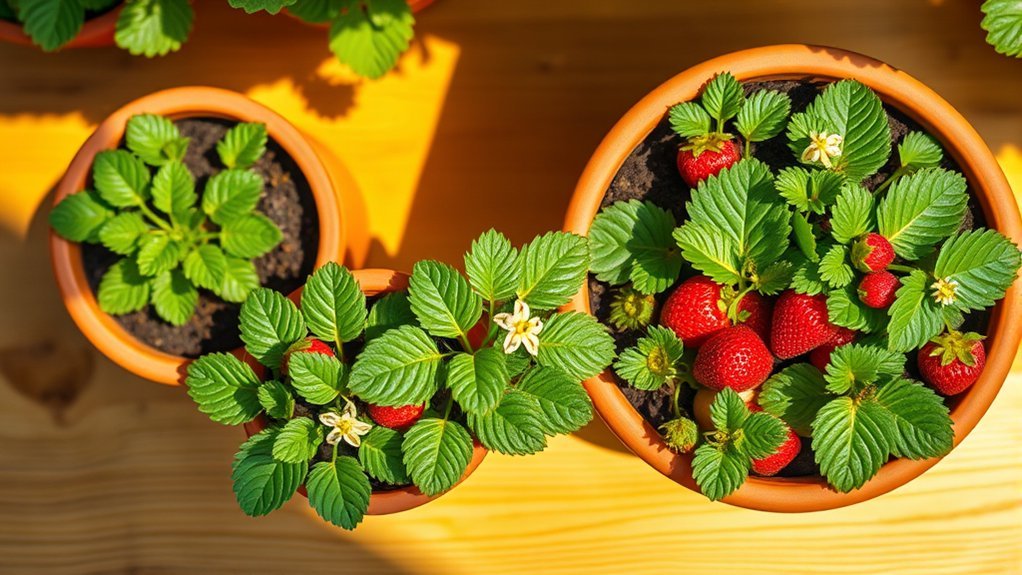
You’ll want to think about how many strawberry plants can comfortably fit in your container. This way, each plant will have enough root space to really thrive.
The shape and size of your pot play a big role in how densely you can plant and how good your fruit will be.
Let’s dive into the best options for different pot sizes so your strawberries can grow strong and healthy. It’s all about finding that perfect balance between space and number of plants!
Plant Density Per Pot
When choosing a pot size for your strawberries, consider how many plants each container can support without overcrowding.
Maintaining the right plant density per pot is key to healthy growth and fruit production. Here’s what to keep in mind:
Each strawberry plant needs about 1 square foot of space in containers.
For 5-gallon pots (12” diameter), fit 3-4 plants comfortably.
In 7-gallon pots (13” diameter), you can plant 4-5 strawberries.
Avoid exceeding 3-4 plants per square foot to prevent competition.
Round pots should be at least 12 inches in diameter for ideal density.
Optimal Root Space
Selecting the right pot size plays a crucial role in ensuring your strawberries have enough root space to thrive. For ideal root space, use at least a 5-gallon pot, which comfortably fits 3-4 strawberry plants per square foot without overcrowding.
A 7-gallon pot offers even more room, supporting larger root systems and potentially bigger fruit, also suitable for 3-4 plants.
Since strawberry roots grow up to 6 inches deep and 12 inches wide, containers need to be deep and wide enough to prevent root binding.
Round pots should be at least 12 inches in diameter, while rectangular ones should measure 24 inches long.
Choosing the right size and shape helps you maximize growing strawberries healthily by giving roots the space they need.
Container Shape Impact
Although container size is important, the shape also plays a crucial role in how many strawberry plants you can grow effectively. The container shape influences root space and plant spacing, directly impacting yield and fruit quality.
When choosing containers, consider these points:
Long narrow containers allow better space use and often yield more strawberries than round ones. Round containers need at least a 12-inch diameter for healthy root growth.
Rectangular containers should be at least 24 inches long to fit more plants comfortably.
Each strawberry plant requires roughly 3-4 plants per square foot to avoid overcrowding. A 5-gallon pot (12” diameter) fits 2-3 plants; a 7-gallon pot (13” diameter) fits 3-4 plants, promoting better fruit size.
Picking the right container shape guarantees your strawberries thrive and produce abundantly.
Picking the Right Pot Size: 5-Gallon vs. 7-Gallon for Strawberries
Choosing between a 5-gallon and a 7-gallon pot can greatly impact your strawberry plants’ health and yield. A 5-gallon container, measuring 12 inches in diameter and 10 inches deep, fits 3-4 strawberry plants and suits small to moderate growing spaces.
However, a 7-gallon container, slightly larger at 13 inches wide and 12 inches deep, offers more root room, helping strawberries grow healthier and stronger.
Larger containers like the 7-gallon retain water better, maintaining consistent moisture essential for strawberries’ root development.
While both sizes support everbearing and day-neutral varieties, the 7-gallon pot’s depth and volume provide an advantage in water retention and root space.
Choosing the right container means balancing available space with your strawberries’ needs for water and growth.
How Container Size Affects Strawberry Fruit Size and Yield
You’ll notice that giving your strawberry plants more root space in larger containers directly boosts both fruit size and overall yield.
When the roots have plenty of room to spread out, the plants can absorb more nutrients and water, which really helps the berries grow bigger.
On the other hand, smaller pots can restrict root growth, making it harder for the plants to get what they need.
This usually means smaller berries and fewer harvests overall.
Root Space Impact
When you provide strawberries with at least 12 inches of root space, their roots can grow fully, leading to larger, healthier fruit. The root space impact is vital because cramped roots limit nutrient uptake, stunting growth and fruit development.
To optimize your strawberry container planting, consider these points:
- Roots spread about 12 inches wide, so choose containers accordingly.
- Smaller containers restrict root growth, reducing fruit size.
- Larger containers, like 7-gallon pots, promote robust root systems.
- Overcrowding in limited space can decrease overall yield.
- Adequate root space reduces repotting frequency, supporting long-term growth.
Yield And Fruit Size
Providing ample root space not only supports healthy growth but also directly influences the size and yield of your strawberry harvest. Larger containers like 7-gallon pots encourage expansive root systems, resulting in bigger fruits and higher yield compared to smaller 5-gallon pots.
An ideal root depth of around 12 inches guarantees better nutrient uptake, further boosting yield. Furthermore, long narrow containers often outperform round ones of the same volume by enhancing root spreading.
| Container Size | Yield Difference |
|---|---|
| 5-gallon pot | Baseline yield |
| 7-gallon pot | ~30% higher yield |
| Round container | Standard yield |
| Long narrow pot | Increased yield due to better root spread |
Choose your container wisely to maximize fruit size and yield.
Why Soil Volume Matters for Happy Strawberry Plants
Because strawberry plants develop extensive root systems, they need at least 5 to 7 gallons of soil to grow well. Adequate soil volume guarantees your plants have enough space to spread roots, access nutrients, and maintain moisture.
Without enough soil volume, roots get cramped, limiting growth and fruit size.
Insufficient soil space restricts root growth, leading to smaller plants and reduced fruit production.
Here’s why soil volume matters:
- Supports healthy root expansion with at least 6 inches depth and 12 inches width
- Prevents overcrowding, reducing competition for nutrients and water
- Retains moisture longer, vital for container-grown strawberries
- Enhances nutrient availability when using quality potting mixes
- Encourages robust plant growth and higher fruit yield
Choosing the right soil volume sets your strawberries up for success, keeping them happy and productive.
Drainage and Airflow Considerations for Strawberry Containers
Two key factors you must focus on for healthy strawberry containers are drainage and airflow. Proper drainage prevents waterlogging and root rot, while good airflow reduces disease risks and promotes strong roots. Choose containers at least 12 inches in diameter, and consider fabric pots. They improve drainage and aeration by letting excess moisture escape.
Here’s a quick summary of drainage and airflow considerations for strawberry containers:
| Feature | Benefit |
|---|---|
| Drainage holes | Prevent waterlogging |
| Elevated planters | Enhance airflow around roots |
| 12-inch diameter pot | Adequate root space and airflow |
| Fabric pots | Improve moisture escape |
| Regular moisture check | Avoid drying out or overwatering |
Focus on these to keep your strawberries thriving in containers.
Watering Frequency Based on Strawberry Container Size
Choosing the right watering schedule depends largely on your strawberry container’s size. Smaller containers, like 5-gallon pots, dry out quickly and need watering checks multiple times daily, especially in hot weather.
Watering frequency hinges on container size—smaller pots dry out fast and require more frequent checks, especially when it’s hot.
Larger containers, such as 7-gallon pots, hold moisture longer, so you can water less often but still keep soil consistently moist.
To optimize watering frequency, keep these tips in mind:
- Check soil moisture regularly, regardless of container size
- Use containers with good drainage to avoid overwatering
- Apply mulch to retain moisture and regulate temperature
- Water smaller pots more frequently to prevent drying out
- Adjust watering frequency seasonally and based on weather conditions
Using Self-Watering Pots to Improve Moisture Retention
If you want to keep your strawberry plants consistently moist without constant watering, self-watering pots offer an effective solution.
These pots feature a reservoir that maintains steady moisture levels, so you don’t have to water as often.
A wicking system draws water up into the soil, encouraging healthy root growth and preventing overwatering.
Using self-watering pots can reduce common problems like wilting and blossom drop, helping your strawberries produce more fruit.
They’re especially helpful during hot or dry weather since they improve moisture retention.
Plus, self-watering pots come in various sizes, letting you pick the right one based on your strawberry plants’ root space needs.
Choosing these containers makes managing moisture easier and promotes stronger, healthier strawberry growth.
Adjusting Fertilization for Container-Grown Strawberries
Maintaining consistent moisture with self-watering pots lays a strong foundation, but feeding your container-grown strawberries properly helps them thrive even more.
Adjusting fertilization for container-grown strawberries is essential since limited soil volume means nutrients per pot get used up faster.
Here’s how to keep your plants healthy:
Apply 1 cup of Berry Tone monthly per pot for balanced growth and fruiting.
Use LABs weekly as a soil drench and foliar spray to boost plant health.
Alternate weekly between Compost Tea and Fish Hydrolysate to supply varied nutrients.
Skip Compost Tea during Berry Tone application weeks to prevent nutrient overload.
Monitor plant health and adjust feeding based on growth stages for ideal results.
Following this schedule helps your strawberries flourish in containers.
Frequently Asked Questions
Can Strawberries Be Grown in Hanging Baskets?
Yes, you can grow strawberries in hanging baskets, and they’re a great choice for this.
Hanging baskets keep your strawberries off the ground, reducing pests and allowing better airflow.
Just make sure you choose a basket with at least 12 inches in diameter and use quality potting mix with good drainage.
Water them regularly since hanging baskets dry out faster.
You’ll enjoy fresh strawberries right from your hanging baskets all season long!
What Is the Best Soil Type for Container Strawberries?
Imagine your strawberries thriving like a well-tuned orchestra, each instrument playing its part perfectly.
The best soil composition for container strawberries includes compost, vermiculite, and peat moss. These ingredients give your plants nutrients and moisture balance.
You’ll want slightly acidic soil, around pH 5.5 to 6.5, to help nutrient uptake.
Quality potting mix prevents waterlogging and supports roots, so you keep your berries healthy and productive, just like a harmonious symphony.
How Do Temperature Fluctuations Affect Container-Grown Strawberries?
Temperature impact on container-grown strawberries can stress your plants since their roots lack insulation.
You’ll notice quicker soil drying or sogginess during fluctuations, which harms growth.
To protect your strawberries, keep moisture consistent and monitor soil pH, as temperature changes affect acidity.
In cold weather, move containers indoors or insulate them.
During heat, provide shade and water regularly to prevent wilting and heat stress.
Can Companion Plants Improve Strawberry Growth in Containers?
You can definitely boost your strawberry growth with companion plants in containers. For example, planting basil nearby offers excellent companion benefits by repelling pests and enhancing flavor. This helps your strawberries thrive without extra chemicals.
Just make sure you pick companions like marigolds or chives that share similar light and water needs. That way, all plants grow well together and maximize the limited space in your container garden.
What Are the Common Pests for Container Strawberries?
You’ll often face pests like aphids, spider mites, whiteflies, slugs, snails, root weevils, and thrips when growing strawberries in containers.
These critters can damage leaves, roots, and fruit, reducing your yield.
For effective pest management, keep a close eye on your plants and use barriers like row covers or nets.
Regular monitoring and quick action help you protect your strawberries and enjoy a healthy harvest.
Conclusion
Choosing the right container size means ensuring healthy roots, promoting robust growth, and maximizing fruit yield. It means picking pots deep enough for root expansion, wide enough for multiple plants, and designed for proper drainage and airflow.
It means watering thoughtfully, fertilizing wisely, and sometimes using self-watering options to keep moisture steady. By giving your strawberries the right space and care, you’re setting yourself up for sweeter harvests, stronger plants, and gardening success.