
What Does the Strawberry Moon Look Like?
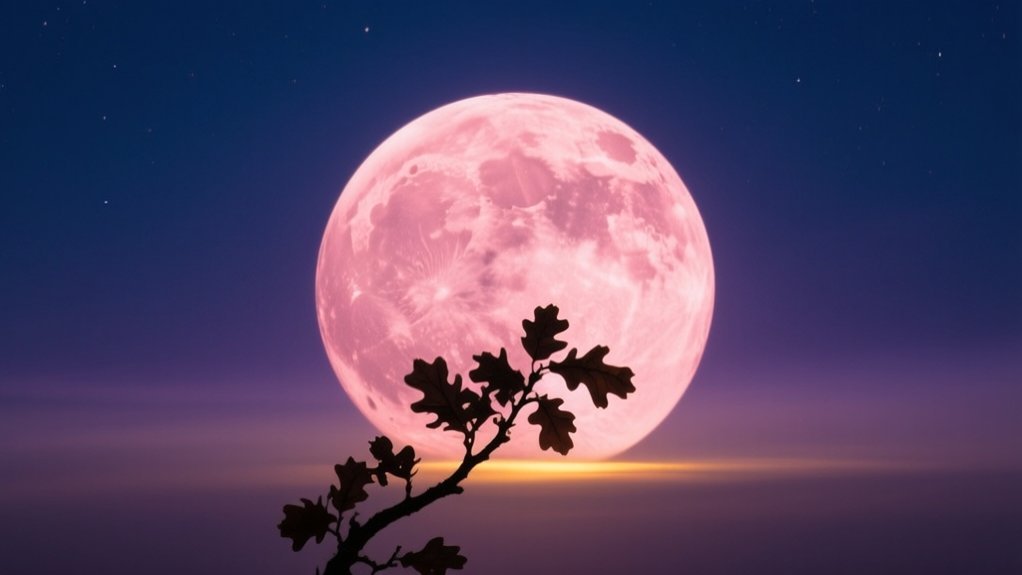
When you see the Strawberry Moon, it glows with warm yellow-orange hues near the horizon, thanks to atmospheric scattering and humidity. As it rises, its color brightens to a crisp white or subtle pink.
It often looks bigger near the horizon due to a visual illusion your brain plays by comparing the moon’s size to nearby objects. Its beautiful glow and size make it a breathtaking sight you’ll want to explore in more detail.
What Is the Strawberry Moon?
The Strawberry Moon marks the full moon in June, named for the time when wild strawberries ripen, especially in Native American traditions like those of the Algonquin tribe.
The Strawberry Moon is June’s full moon, named for the season when wild strawberries ripen.
You’ll find that the Strawberry Moon is one of many Full Moon names rooted in agricultural and seasonal events. These names help people connect with nature’s cycles, reflecting activities like planting, harvesting, and blooming.
The Strawberry Moon often appears low in the sky, signaling summer’s arrival. In 2026, it will peak on June 29 at 7:56 P.M. Eastern Time.
Beyond its name, this moon carries cultural significance, associated with good luck for marriages and favorable fishing and harvesting conditions.
Understanding the Strawberry Moon enriches your appreciation of these natural rhythms and their deep historical roots.
What Colors Does the Strawberry Moon Usually Show?
When you spot the Strawberry Moon near the horizon, you’ll often notice a warm yellow-orange glow. This happens because the atmosphere scatters the light in a way that gives it that cozy color.
Then, as the moon climbs higher in the sky, it usually brightens to a whiter tone, although it can still hold onto a soft, warm hue. Of course, the exact colors you see can really depend on the local weather and your viewing location.
Typical Moon Colors
Although you might expect the Strawberry Moon to always glow pink, it usually shows a yellow-orange tint when low on the horizon due to atmospheric scattering.
As you watch it rise higher, the typical moon colors shift to a brighter white or pale yellow.
Occasionally, you might catch a subtle pink hue, but that’s less common and depends on specific atmospheric conditions.
Unlike the deep red of a blood moon during an eclipse, the Strawberry Moon’s colors remain warm and gentle.
Atmospheric Effects Influence
Because atmospheric conditions play a major role, you’ll often see the Strawberry Moon glowing with a yellow-orange tint as it rises near the horizon.
This June full moon’s colors come from how light scatters through the atmosphere, changing what you perceive.
Depending on local weather, the moon’s hue varies, making each sighting unique.
Here’s what influences the colors you usually see:
- Atmospheric scattering creates warm yellow-orange tones near the horizon
- Increased humidity and particles during June brighten and enrich the moon’s color
- Cloud cover and air clarity can deepen or soften its tint
- Sometimes, a reddish or pinkish glow appears, especially when the moon is low
These atmospheric conditions make the Strawberry Moon’s appearance both beautiful and dynamic.
Color Variations Explained
You’ll notice the Strawberry Moon often shows a warm yellow-orange tint near the horizon, thanks to atmospheric scattering that enhances its colors.
As it rises higher, its hue usually shifts to a white or silvery shade, losing the intense warm tones.
These color variations depend on factors like local weather, pollution, and time of day.
Sometimes, especially during sunset or twilight, you might even catch subtle pink or orange hues.
During special lunar events, such as major lunar standstills, the Strawberry Moon hangs lower in the sky, making its warm colors more pronounced.
Why Does the Strawberry Moon Seem to Change Size?
You might notice the Strawberry Moon looks bigger when it’s near the horizon. This happens because of a trick called the moon illusion.
Also, atmospheric conditions like humidity can make it seem brighter and larger.
Moon Illusion Explained
Why does the Strawberry Moon seem larger when it’s near the horizon? The answer lies in the moon illusion, a fascinating optical trick your brain plays on you. When the Full Strawberry Moon hangs low, your brain compares it to nearby objects, making the Moon appear bigger than when it’s high in the sky. Despite this, the Moon’s actual size never changes.
Here’s what you should know about this illusion:
- The Moon looks larger near the horizon due to visual context.
- Your brain uses horizon objects as size references.
- The effect is stronger during full moons like the Strawberry Moon.
- Psychological studies show it’s about perception, not actual size.
Atmospheric Effects Role
Although the Strawberry Moon’s size never truly changes, atmospheric effects can influence how you perceive it.
When the moon is near the horizon, atmospheric conditions like humidity and airborne particles scatter light, often giving the moon a warm yellow or orange glow. This color shift enhances its presence, making it seem more striking.
Combined with the moon illusion, a psychological effect where the moon looks larger against terrestrial objects, this can make the Strawberry Moon appear bigger than it really is.
As the moon rises, it moves through different atmospheric layers, subtly altering how you see it from your location.
Why Does the Strawberry Moon Look Bigger Near the Horizon?
Ever noticed how the Strawberry Moon seems enormous when it’s near the horizon? This effect is called the moon illusion. Your brain tricks you into seeing the full moon as much bigger than it really is.
When the moon is low, your eyes compare it to nearby objects, making it appear larger than when it’s high in the sky. Here’s why it happens:
Your brain perceives the moon’s size relative to foreground objects. The moon’s actual diameter stays constant at about 3,474 kilometers.
The moon illusion occurs regardless of its phase, including full moon. Atmospheric conditions near the horizon can enhance the moon’s color, adding to its perceived size.
How Atmosphere Affects the Strawberry Moon’s Glow
When you watch the Strawberry Moon near the horizon, you might notice its glow seems to change a bit. That’s because the atmosphere scatters light in different ways depending on what’s in the air.
For example, particles and moisture floating around can make the moon look more reddish or orange, really bringing out those warm colors.
Plus, where you’re plays a role too—it can affect just how bright and colorful the moon appears to you.
Atmospheric Light Scattering
Because the Strawberry Moon often appears near the horizon, you’ll notice its glow shifts to yellow-orange or reddish hues. This color change happens due to atmospheric light scattering, which alters how the moon’s light reaches your eyes.
When the Strawberry Moon is low, its light passes through more atmosphere, scattering shorter blue wavelengths and letting longer red and orange wavelengths dominate.
Here’s what you should know about atmospheric light scattering and the Strawberry Moon:
- The effect intensifies as the moon rises from the horizon.
- It makes the moon appear larger and more colorful.
- Local conditions like humidity and pollution can tweak the moon’s glow.
- This scattering happens with all celestial bodies near the horizon but is especially striking with the Strawberry Moon.
You’ll see the moon’s warm glow thanks to this fascinating atmospheric process.
Horizon Color Variations
Although the Strawberry Moon’s glow changes throughout the night, you’ll notice its reddish hue is most vivid near the horizon. This happens because the moon’s light travels through more atmosphere at low altitudes, filtering out shorter wavelengths and letting reds and oranges dominate.
As it rises, the horizon color variations shift, making the moon look brighter and whiter. Local conditions like humidity can tweak this effect, but the reddish glow remains strongest close to the horizon.
| Moon Position | Color Appearance | Reason |
|---|---|---|
| Near Horizon | Reddish Hue | Longer atmospheric path |
| Mid-Altitude | Yellow-Orange | Moderate light scattering |
| High Above Horizon | Bright White | Minimal atmospheric filtering |
Airborne Particles Influence
As airborne particles scatter the moon’s light, you’ll often see the Strawberry Moon take on a richer reddish or orange hue, especially when it hangs low near the horizon.
The atmosphere plays an essential role in this transformation by filtering and bending the light that reaches your eyes.
Here’s how airborne particles influence its glow:
- Scatter shorter wavelengths (blue and green), letting reds and oranges dominate
- Enhance color intensity based on humidity and pollution levels
- Cause variations in brightness and hue depending on local weather
- Make the moon appear larger and more vibrant near the horizon due to longer light travel through the atmosphere
How Weather and Location Change Your Strawberry Moon View
Your experience of the Strawberry Moon depends heavily on where you’re and the weather conditions around you. Visibility plays a vital role, as atmospheric conditions like humidity, air pollution, and cloud cover can dramatically alter what you see.
If the sky is clear, you’ll enjoy the moon’s vibrant hues and a larger appearance when it’s near the horizon, thanks to light scattering. However, clouds can obscure the moon, making it look like a plain white orb or hiding it completely.
Your geographic location also affects your view; some places reveal striking colors, while others show a more muted moon.
Cultural Stories Behind the Strawberry Moon
When you hear the name “Strawberry Moon,” it connects you to Native American traditions, especially those of the Algonquin tribes. They named it to mark the ripening of wild strawberries in June. This moon carries rich cultural stories tied to nature’s cycles and agricultural milestones.
You’ll find that various Native American names reflect these seasonal changes and the abundance of the land. The Algonquin called it the “Strawberry Moon” to celebrate strawberry harvests.
Native American names beautifully reflect the seasons and the land’s abundance, like the Algonquin’s Strawberry Moon celebrating harvests.
Other tribes named it “Berries Ripen Moon” or “Green Corn Moon,” highlighting crop readiness. European cultures referred to it as “Honey Moon,” linking it to marriage and honey gathering.
These names honor the full moon’s role in marking summer’s arrival and nature’s bounty. Through these stories, you connect deeply with the rhythms of the earth.
When and Where Is the Strawberry Moon Easiest to See?
The rich cultural stories behind the Strawberry Moon make its appearance even more special.
You’ll find the best time to see it’s on June 29, 2026, around 7:56 P.M. Eastern Time, when it reaches its peak.
The Strawberry Moon is easiest to spot near the horizon at moonrise, where its reddish or orange hue becomes vivid due to atmospheric scattering.
If you’re in New York, you’ll have ideal viewing conditions, along with places like Florida.
Don’t miss this chance, as a similar low full moon won’t happen again until 2043.
Watching the Strawberry Moon rise low in the sky offers a unique and breathtaking experience that connects you to both nature and tradition.
Famous Strawberry Moon Photographs
Several iconic photographs have captured the Strawberry Moon’s striking colors and low position on the horizon, making it appear larger and more vibrant than usual.
These famous photographs highlight its unique pink and orange hues caused by atmospheric scattering.
On June 11, 2025, many photographers documented this spectacle worldwide, emphasizing its cultural and visual impact.
You’ll find notable images showcasing the Strawberry Moon:
- Rising behind the Empire State Building in New York
- Illuminating Torre del Serpe in Italy
- Captured by observers in Iraq
- Shared from Montevideo, Uruguay
These famous photographs reveal how geography and atmosphere influence the Strawberry Moon’s appearance, giving you a glimpse of its global allure and stunning beauty.
How to Photograph the Strawberry Moon
Iconic images of the Strawberry Moon show how enchanting this celestial event can be, but capturing its beauty yourself takes some planning. To photograph the Strawberry Moon effectively, you’ll want a zoom lens, low ISO, and a tripod for stability. Adjust exposure times to avoid overexposure and try including foreground elements for depth.
| Step | Tip | Reason |
|---|---|---|
| Use zoom lens | Bring moon closer | Capture fine details |
| Set low ISO | Around 100-200 | Reduce image noise |
| Stabilize camera | Use a tripod | Prevent blur from shake |
| Adjust exposure | 1/125–1/2000 seconds | Balance brightness |
| Add foreground | Trees or buildings | Create dynamic composition |
Follow these steps to photograph the Strawberry Moon with clarity and style.
Frequently Asked Questions
Can the Strawberry Moon Affect Tides Differently Than Other Full Moons?
No, the Strawberry Moon doesn’t affect tide patterns differently than other full moons.
You’ll notice that its lunar influence on tides is similar because all full moons exert comparable gravitational pull on Earth’s waters.
While tide patterns can be stronger if the full moon occurs near perigee, the Strawberry Moon itself doesn’t cause unique tidal changes.
Is the Strawberry Moon Visible From Every Continent?
Yes, you can observe the Strawberry Moon visibility from every continent, thanks to global moon phases that affect the entire Earth.
Depending on where you are, local weather and geographic factors might change how clearly you see it, but the full moon itself is visible worldwide.
So, no matter your location, you’re part of a global audience experiencing this beautiful celestial event during its peak.
Just check your local viewing times!
Does the Strawberry Moon Have Any Impact on Wildlife Behavior?
You might think the Strawberry Moon is just a pretty sight, but it actually influences wildlife activity a lot.
During its bright full phase, you’ll notice increased nocturnal behavior in animals like owls and foxes, who adjust their hunting strategies.
Birds and mammals also become more active, using the extra light to forage or mate.
How Long Does the Strawberry Moon Remain Full Each Night?
You can expect the Strawberry Moon to remain full for about three nights during its moon phases within the lunar cycles, with the peak night being the brightest and most fully illuminated.
Each night, it typically stays visible all night long, rising at sunset and setting at sunrise.
However, how long you see it clearly depends on atmospheric conditions and your location.
Are There Any Myths About the Strawberry Moon Causing Weather Changes?
Yes, you’ll find plenty of Strawberry Moon myths tied to weather folklore.
Many believe this full moon signals upcoming rainy or stormy weather, linking it to shifts in seasons and crop cycles.
While science hasn’t proven a direct effect, farmers and cultures have long noticed patterns during the Strawberry Moon.
Conclusion
Now that you know what makes the Strawberry Moon so special, here’s a fun fact: it’s called the Strawberry Moon because it usually appears in June, signaling the strawberry harvest season.
You’ll often see it glowing with warm pinkish or reddish hues, especially near the horizon. So next time you catch a glimpse, remember you’re witnessing a beautiful natural event tied to both science and culture, making your view even more magical!