
Key Features of Strawberry Plants: What Do They Look Like?
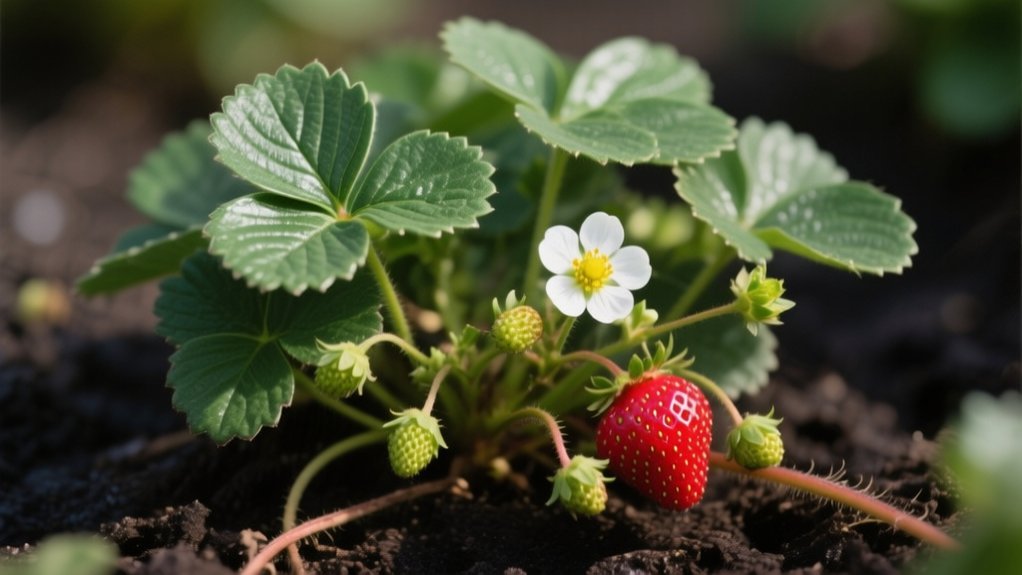
You’ll spot strawberry plants by their dark green, serrated leaves sitting low to the ground and their firm, plump crowns at the center. Look for runners, thin stems that stretch out and root to form new plants nearby.
The shallow roots usually stay within the top three inches of soil. When flowers bloom white and fruits ripen red, you know the plant is healthy. Keep exploring to better understand their growth and care.
Overview of Strawberry Plant Anatomy and Appearance
Although strawberry plants might look simple at first glance, they’ve five key parts you should know: leaves, root system, crown, stolons (runners), and daughter plants.
The leaves absorb nutrients and sunlight, fueling photosynthesis. You’ll notice they’re typically dark green with serrated edges, growing close to the ground.
The root system stays shallow, mostly within the top three inches of soil, anchoring the plant.
At the center, the crown contains the plant’s growth energy, producing both flowers that develop into fruit and stolons.
These stolons, or runners, stretch out horizontally, rooting wherever they touch soil to form new daughter plants.
This natural spread helps strawberries multiply efficiently, ensuring you get plenty of fruit season after season.
How Strawberry Leaves and Crowns Look and Function
You’ll notice strawberry leaves are green and serrated, made up of several leaflets that capture sunlight for photosynthesis.
Just above the soil, the crown acts as the growth hub. It produces new leaves, runners, and flowers.
Keeping both healthy is key because it guarantees your plant gets the energy and nutrients it needs to thrive and spread.
Leaf Structure And Role
Strawberry leaves have a distinctive trifoliate structure, with each leaf made up of three serrated leaflets that range in color from dark to light green depending on the variety and health of the plant.
This leaf structure plays a crucial role in photosynthesis, capturing sunlight to fuel growth.
The crowns, located just above the soil, store nutrients essential for producing new leaves, runners, and flowers.
Your strawberry plant’s root system is shallow, making healthy leaves important for efficient nutrient uptake.
Remember, healthy leaves support vigorous crown development and overall plant health.
- Trifoliate leaves consist of three serrated leaflets
- Photosynthesis in leaves converts sunlight into energy
- Crowns store energy for new growth
- Shallow root system depends on nutrient uptake from upper soil
- Healthy leaves guarantee robust crown and fruit production
Crown Growth Function
The crown sits at the soil surface, acting as the main growth hub where leaf stems and roots emerge. In strawberry plants, this thickened part stores energy crucial for producing flower stalks and runners that drive growth and reproduction.
You’ll notice healthy crowns are firm and plump, signaling robust overall health. The leaves surrounding the crown play a supporting role by capturing sunlight to produce energy, fueling the crown’s activity.
When the crown thrives, your strawberry plants can maintain steady growth and produce higher fruit yield with better quality. Conversely, damaged or weak crowns often result in poor plant vigor and reduced productivity.
Photosynthesis And Nutrients
Although leaves often get the spotlight for their role in photosynthesis, the crown plays an equally essential part in supporting growth and fruit production. Strawberry leaves, rich in chlorophyll, efficiently capture sunlight to convert into energy.
Meanwhile, the crown stores growth energy and initiates runners and flowers. Together with the root system, they absorb water and nutrients critical for the plant’s health and fruit production.
Key points to understand about photosynthesis and nutrients in strawberry plants include:
- Strawberry leaves are green, serrated, and palmate, maximizing sunlight capture.
- Chlorophyll in the leaves drives photosynthesis, powering growth.
- The crown supports flowering and runner development.
- The root system absorbs water and essential nutrients.
- Healthy leaves and crowns directly influence fruit quality and yield.
You’ll see how these parts work together to keep your strawberry plants thriving.
What Strawberry Runners (Stolons) Look Like and How They Spread the Plant
You’ll notice strawberry runners are long, thin stems that stretch out horizontally from the main plant.
These runners root themselves in the soil to form new daughter plants, helping the strawberry spread across your garden.
Runner Appearance Description
When strawberry plants send out runners, you’ll notice long, slender stems stretching horizontally just above the soil. These runner plants are essential for vegetative propagation, allowing the strawberry plants to spread efficiently.
Strawberry plants produce these stolons to form new, genetically identical daughter plants. Here’s what you should know about the appearance of runners:
- They extend from the base of the parent plant along the ground.
- Nodes along runners develop roots to establish new plants.
- Daughter plants grow at these nodes, eventually becoming independent.
- Runners help cover larger areas without seed production.
- You can manage runners to control plant density or encourage expansion.
Spreading Mechanism Explained
Since strawberry plants rely heavily on runners, or stolons, to spread, understanding their structure is key to managing your garden effectively.
These runners are long, horizontal stems that grow from the parent plant’s leaf axils, extending several feet across your strawberry beds. As they touch the soil, they root and propagate new daughter plants. Each daughter plant forms its own root system, allowing it to grow independently while still connected to the original.
This spreading mechanism helps strawberry plants cover ground quickly under favorable growing conditions.
However, effective management of runners is crucial to prevent overcrowding and maintain healthy plants. By monitoring and controlling runner growth, you guarantee your strawberry beds stay productive and well-organized, maximizing both space and harvest potential.
Establishing Daughter Plants
Although strawberry runners, or stolons, might look like simple horizontal stems, they play an essential role in spreading your plants by producing new daughter plants at their tips.
These stolons grow along the ground and root at points to establish new plants, allowing rapid propagation.
You’ll notice June-bearing varieties produce more runners compared to ever-bearing varieties, which influences how you manage propagation.
Keep an eye on overcrowding because too many daughter plants can reduce health and productivity.
To effectively establish daughter plants, remember these key points:
- Runners emerge mainly in late spring and summer
- Roots form when stolons touch soil
- Daughter plants expand your strawberry bed
- Fewer runners come from ever-bearing varieties
- Thinning runners prevents overcrowding and guarantees vigor
Managing stolons smartly keeps your strawberry patch thriving.
Identifying Healthy Roots in Strawberry Plants
Healthy roots are fundamental for your strawberry plants to thrive, as they guarantee the plant absorbs the moisture and nutrients it needs.
Look for healthy roots that are straw-colored and firm, showing healthy vigor without any signs of root rot, which appears as blackened, mushy roots.
A well-established root system spreads a network of fine roots in the top three inches of soil, so proper topsoil maintenance is essential.
When planting, make sure the roots are carefully spread out in the planting hole without crowding, promoting better growth.
Avoid any discoloration or decay, as these indicate disease or poor health and require immediate attention to keep your strawberry plants flourishing.
The Different Types of Strawberry Plants by Appearance
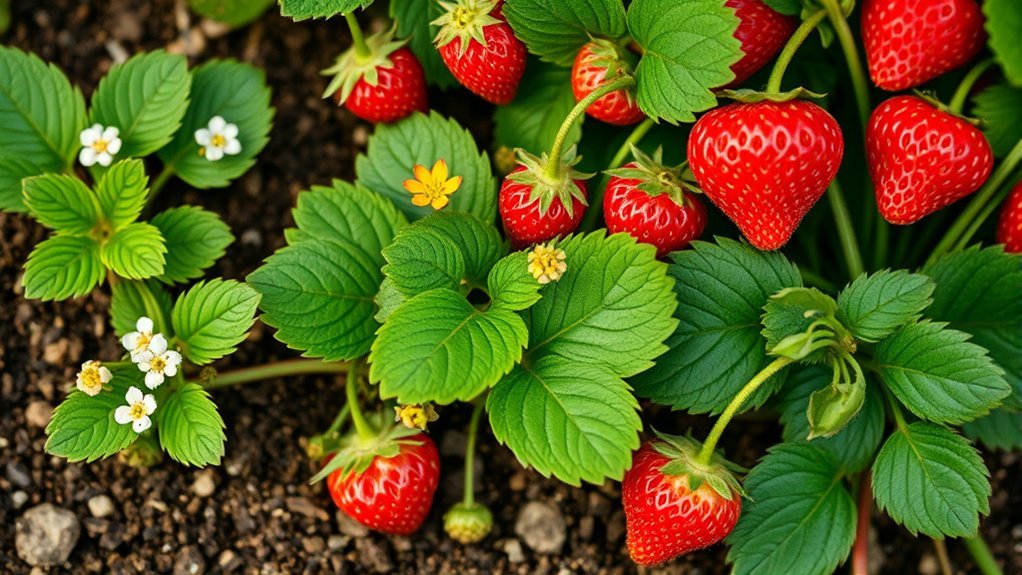
When you take a closer look at strawberry plants, you’ll start to notice differences in their leaves and crown structures.
These little details actually help you figure out which type of strawberry plant you’re dealing with. Plus, some of these plants send out runners that sprout new daughter plants, which is how they naturally expand their patch.
Once you understand these traits, it becomes a lot easier to recognize each variety and know how to care for them properly.
Leaf And Crown Structure
Since the crown serves as the plant’s growth point, you’ll often notice strawberry plants have a thickened stem at soil level. From this point, leaves, flowers, and runners emerge.
The leaf structure typically features compound leaves made up of three to five serrated leaflets. These leaflets display dark green foliage, varying in size depending on the cultivar.
Understanding the crown and leaf structure helps you identify different strawberry types. Key features include:
- Crown as the centralized growth point
- Compound leaves with serrated leaflets
- Dark green, robust foliage
- Variation in leaf size by strawberry variety
- Runners emerging from the crown (but not detailed here)
This structure supports the plant’s growth and eventual fruit production, making it essential for healthy strawberry plants.
Runner And Daughter Plants
Although the crown remains the plant’s central hub, you’ll notice strawberry plants spread quickly through runners, which are horizontal stems that creep along the ground and produce daughter plants at their nodes.
These daughter plants are small, independent offshoots that develop their own roots, allowing them to establish themselves nearby.
This natural propagation method helps the strawberry patch expand efficiently without extra effort.
From the crown, you’ll also see flowering stalks rise, bearing white or pink flowers that turn into bright red, juicy fruit.
The combination of runners and daughter plants guarantees your strawberry bed grows dense and productive, with each new plant able to contribute to a bountiful harvest.
Understanding this growth pattern helps you manage and multiply your strawberry plants effectively.
How Strawberry Flowers Develop and Support Fruit Formation
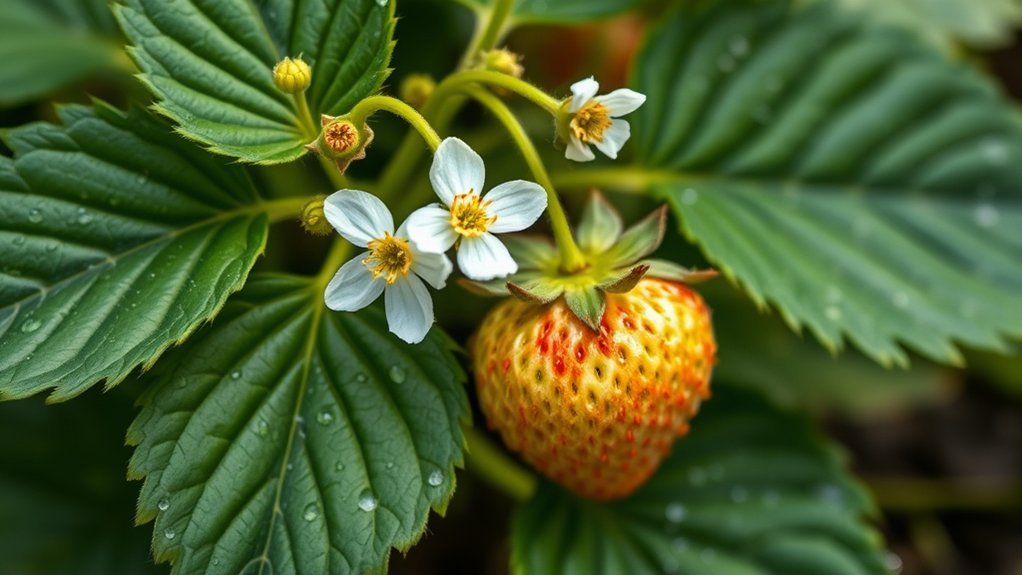
Because strawberry flowers develop from buds formed during the previous growing season, you’ll typically see them bloom in spring. This marks an important stage for fruit formation. Each flower has five white petals, yellow stamens, and a pistil where pollination triggers fertilization.
Pollinators like bees play a significant role in this process, enabling the transformation of flowers into fruit. The flowering stage may last weeks, especially in day-neutral varieties, allowing continuous fruit production.
To maximize yield, proper management is essential, including avoiding insecticides during flowering to protect pollinators.
Key points to keep in mind:
- Strawberry flowers initiate fruit formation after successful pollination
- Day-neutral varieties flower continuously, extending fruit production
- Pollinators facilitate fertilization and fruit set
- Flowering stage duration affects overall yield
- Proper management supports healthy pollinator activity
How Strawberry Fruit Develops and Changes Color
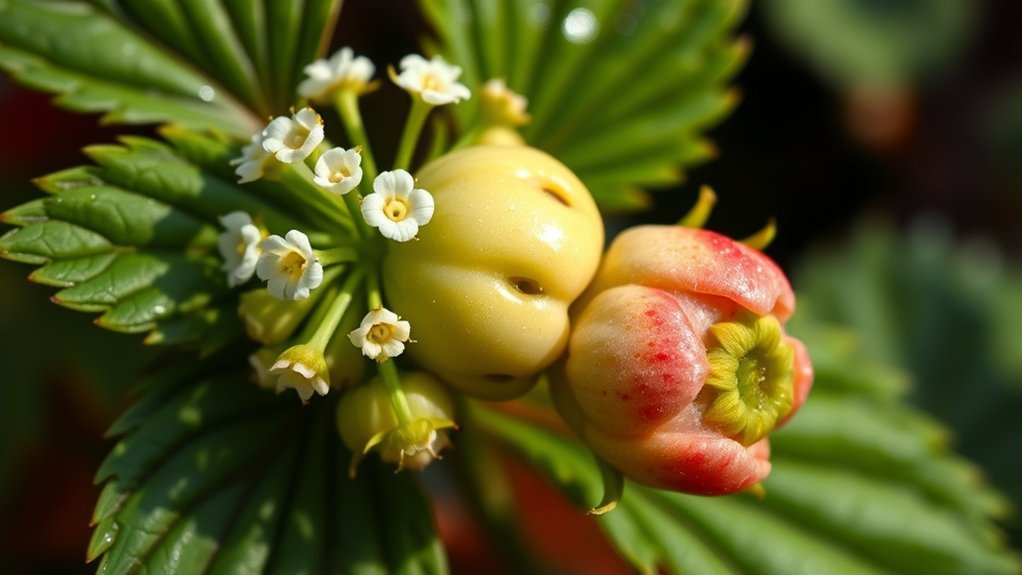
Once strawberry flowers are successfully pollinated, the fruit begins to develop from the ovaries within each bloom. Each strawberry contains around 200 individual ovaries, giving it a unique structure.
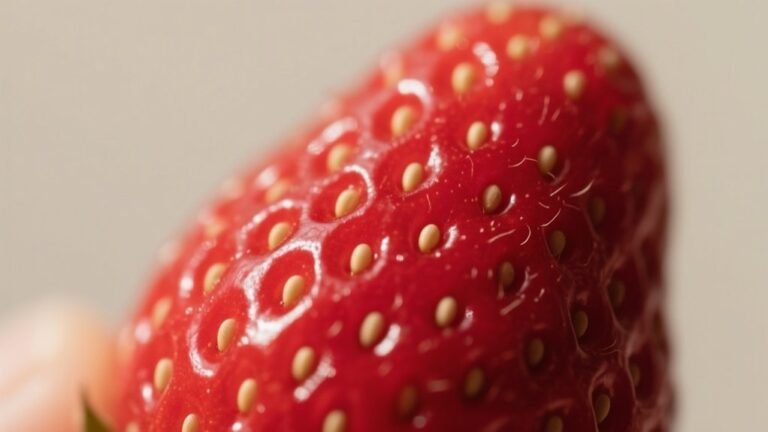
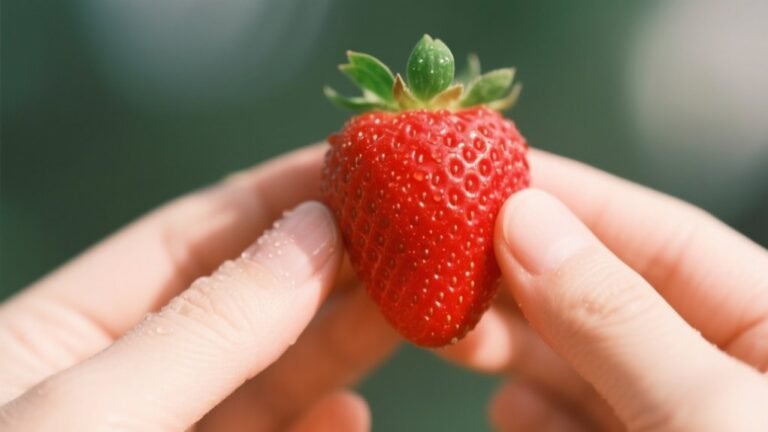
The fruit starts green, then shifts to white, pink, and finally bright red as it ripens. This color change happens because anthocyanins, the pigments responsible for the red hue, accumulate in the fruit.
Environmental factors like sunlight and temperature influence how quickly and intensely anthocyanins develop.
Strawberries typically take about 30 days after pollination to reach ripe berries under ideal conditions. You should harvest the fruit only when it’s fully red and vibrant since unripe strawberries won’t continue ripening once picked.
This way, you get the best flavor and sweetness from your strawberry crop.
How to Tell June-Bearing and Ever-Bearing Strawberries Apart
How can you easily tell June-bearing and ever-bearing strawberries apart? Focus on their flowering and fruiting patterns, as well as fruit characteristics.
June-bearing and ever-bearing strawberries differ significantly in these areas:
June-bearing varieties set flower buds in fall.
June-bearing strawberries initiate their flower buds in the fall season.
Ever-bearing develop them in late spring or early summer.
June-bearing strawberries produce one large harvest mid-June to early July.
Ever-bearing yield two smaller harvests early summer and early fall.
Fruit size and flavor in June-bearing are generally larger and more consistent.
Ever-bearing berries tend to be smaller with variable flavor.
Popular June-bearing varieties include Annapolis and Earliglow.
Ogallala is a well-known ever-bearing variety.
Signs of Stress and Disease in Strawberry Plants
When you notice yellowing leaves on your strawberry plants, it often signals stress from nutrient deficiencies or poor soil conditions, especially nitrogen deficiency.
Wilting plants accompanied by discolored crowns and roots can point to Phytophthora crown rot, a serious disease that demands immediate attention.
Check the roots for black root rot, which appears as dark, blackened roots typically caused by poorly drained soil or compacted ground.
Gray mold shows up as light brown lesions and powdery gray growth on fruit and foliage and can severely affect your harvest if ignored.
Leaf spot diseases manifest as purple spots on leaves, serving as warning signs of underlying problems.
How Seasonal Changes Affect the Look of Strawberry Plants
Recognizing signs of stress and disease helps you protect your strawberry plants, but their appearance also changes naturally throughout the year.
Throughout the seasons, you’ll notice distinct shifts in foliage, flowers, and fruit that reflect the plant’s growth cycle:
In early spring, vibrant green foliage emerges as plants exit dormancy.
Late spring to early summer brings white flowers that turn into fruit, with leaves growing denser.
During summer, runners develop, spreading the plant and creating a sprawling look.
Late summer to early fall, leaves yellow or brown, signaling aging and preparation for dormancy.
By late fall, foliage dies back, revealing the crown, often needing mulch for winter protection.
Understanding these changes lets you care for your strawberry plants effectively year-round.
Frequently Asked Questions
What Is the Best Soil Type for Growing Strawberries?
The best soil for growing strawberries has a slightly acidic pH between 5.5 and 6.8, ensuring ideal nutrient uptake.
You’ll want a rich strawberry soil composition with plenty of organic matter to meet nutrient requirements and improve drainage.
Amend heavy clay with compost for better aeration and use mulching techniques to retain moisture.
Sandy soils also benefit from soil amendments like rotted manure.
Don’t forget companion planting to boost growth and protect your strawberries.
How Often Should Strawberry Plants Be Watered?
You should aim for a watering frequency that provides about 1 to 1.5 inches of water weekly.
Maintaining consistent soil moisture is key, especially during dry weather conditions, to support strong root development and healthy leaf health.
Adjust based on plant size and the growing season.
Morning irrigation methods work best, allowing foliage to dry and reducing disease risk.
Mulching can help retain moisture, so you might water less often while ensuring your strawberries thrive.
Can Strawberry Plants Grow Indoors or in Containers?
Yes, you can grow strawberry plants indoors or in containers. For indoor gardening, choose appropriate container sizes with good soil drainage to prevent root rot.
Confirm your plants get 6 to 8 hours of light daily or use supplemental lighting.
Maintain proper plant spacing to boost air circulation, control temperature around 60-75°F, and use balanced fertilizer options.
Also, keep an eye on pest management to protect your strawberries and enjoy a thriving harvest.
What Pests Commonly Affect Strawberry Plants?
Common strawberry pests swarm your plants like a buzzing cloud of trouble. You’ll face challenges from root weevils, leafrollers, stink bugs, and spotted wing drosophila.
Use pest identification tips to spot damage early, and apply organic pest control methods like beneficial insects and diatomaceous earth.
Pest prevention strategies include planting pest resistant varieties and managing pest populations by reducing moisture.
Stay vigilant to keep strawberry plant diseases at bay and protect your harvest.
How Long Do Strawberry Plants Typically Live?
You can expect a strawberry plant lifespan of about 3 to 5 years, depending on the strawberry varieties longevity and care for strawberries.
Factors affecting lifespan include seasonal growth habits, environmental impacts longevity like soil quality and sunlight, and disease resistance traits.
Using proper propagation techniques strawberries thrive longer.
Conclusion
Now that you know the key features of strawberry plants, you’re better equipped to care for them and enjoy their delicious fruit. Remember, “a stitch in time saves nine.” Catching signs of stress or disease early can save your plants from serious harm.
By understanding their leaves, runners, roots, and fruit development, you’ll nurture healthy strawberries season after season. Keep an eye on their changes, and your garden will reward you with bountiful harvests.