

How to Grow Strawberry Roots
To grow strong strawberry roots, pick bare-root plants like June-bearing or day-neutral varieties in early spring when soil temps reach 50–60°F. Soak roots for 1-2 hours before planting, trimming roots to 4-6 inches and spreading them downward in well-draining, compost-enriched soil.
Space plants 12-18 inches apart and water deeply but avoid overwatering to prevent root rot. Pinch first-year blossoms to help roots strengthen. For tips on boosting growth and avoiding common issues, keep exploring these key practices.
Choose Strawberry Varieties That Promote Strong Roots
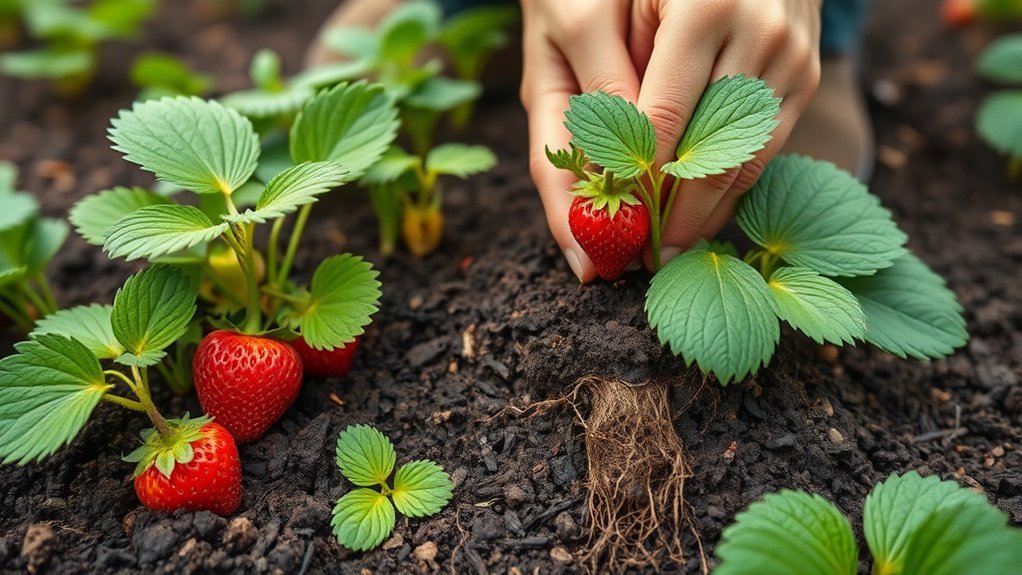
When you choose strawberry varieties that promote strong roots, you set your plants up for a healthy start. Opt for June-bearing varieties like Chandler, known for robust root development and higher yields in the first year.
Choosing strawberry varieties like Chandler ensures strong roots and a healthy, productive start.
If you want consistent fruit with steady root growth, everbearing types such as Seascape work well. Day-neutral varieties like Tribute also encourage continual root establishment throughout the season.
Selecting bare-root plants gives you an advantage, as their dormant state allows for earlier planting and better root development compared to potted options.
Before planting, improve soil quality by mixing in well-rotted compost, which enhances drainage and provides essential nutrients.
These steps guarantee your strawberry varieties develop strong roots, leading to healthier plants and more fruitful harvests.
Plant Strawberry Roots at the Right Time
You’ll want to plant your bare-root strawberries in late winter to early spring, right when the soil is workable but not frozen or muddy.
It’s a sweet spot for getting those roots in the ground.
And here’s a neat fact: strawberry crowns can handle temperatures as low as 10°F.
So, you can actually plant them before the last frost date hits without worrying too much.
If for some reason you can’t get them into the soil right away, don’t stress.
Just pop the roots into your fridge’s crisper drawer, and they’ll stay fresh for up to two weeks.
Handy, right?
Ideal Planting Season
Although bare-root strawberry plants look delicate, planting them during their late winter to early spring dormancy gives them the best chance to establish strong roots before the heat arrives.
This ideal planting season helps you minimize transplant shock and take advantage of cooler soil and spring moisture.
Keep these tips in mind for successful planting:
- Plant as soon as soil is workable, avoiding frozen or muddy conditions.
- Soak bare-root plants in water for 1-2 hours before planting.
- Aim for early spring to align with dormancy and root growth.
- Store bare roots in a refrigerator up to two weeks if you can’t plant immediately.
- Check soil temperature to verify it’s above freezing for crowns and leaves.
Soil Temperature Considerations
Since soil temperature directly affects strawberry root growth, planting at the right time is essential for successful establishment. The ideal soil temperature for planting strawberries ranges between 50°F and 60°F, promoting peak root development.
Plant too early, and soil temperatures below 50°F can stunt root growth and increase rot risk. Conversely, soil that’s warmer than 60°F can stress young roots, causing transplant shock.
Before you plant, perform a soil test using a digital meter or soil thermometer to verify temperatures fall within this ideal range.
For early spring planting, wait until the soil has warmed several weeks past your region’s last frost date.
Monitoring soil temperature carefully helps you avoid setbacks and guarantees your strawberry roots establish strong and healthy.
Storage Before Planting
Knowing the right soil temperature helps you plan when to plant bare-root strawberry plants.
If you can’t plant them immediately, proper storage is key to preserving their viability. Store bare-root strawberry plants in the refrigerator’s crisper drawer, keeping them in their original plastic bag to maintain humidity and extend storage life up to two weeks.
Always monitor the stored roots to avoid drying out or excess moisture. Before planting, remember to soak the roots for 1-2 hours to hydrate and promote strong establishment.
Here are essential tips for storage before planting:
- Store in the crisper drawer, maintaining humidity
- Plant during dormancy in late winter to early spring
- Avoid frozen or muddy soil for planting time
- Soak the roots before planting
- Monitor the stored roots regularly to guarantee health
Store Bare-Root Strawberries Properly Before Planting
You can store bare-root strawberries in your refrigerator’s crisper drawer for up to two weeks by keeping them in their original plastic bag to maintain humidity.
During this storage time, check the roots regularly to guarantee they stay moist but not waterlogged, preventing rot.
Avoid freezing or placing them in overly warm spots, as extreme temperatures can harm the plants.
If you can’t plant immediately, soak the roots in water for 1-2 hours before planting to hydrate them properly.
Proper storage and hydration help keep your bare-root strawberries healthy and ready for planting when the time is right, guaranteeing strong root development and a successful start for your strawberry plants.
Test and Amend Soil for Healthy Strawberry Roots
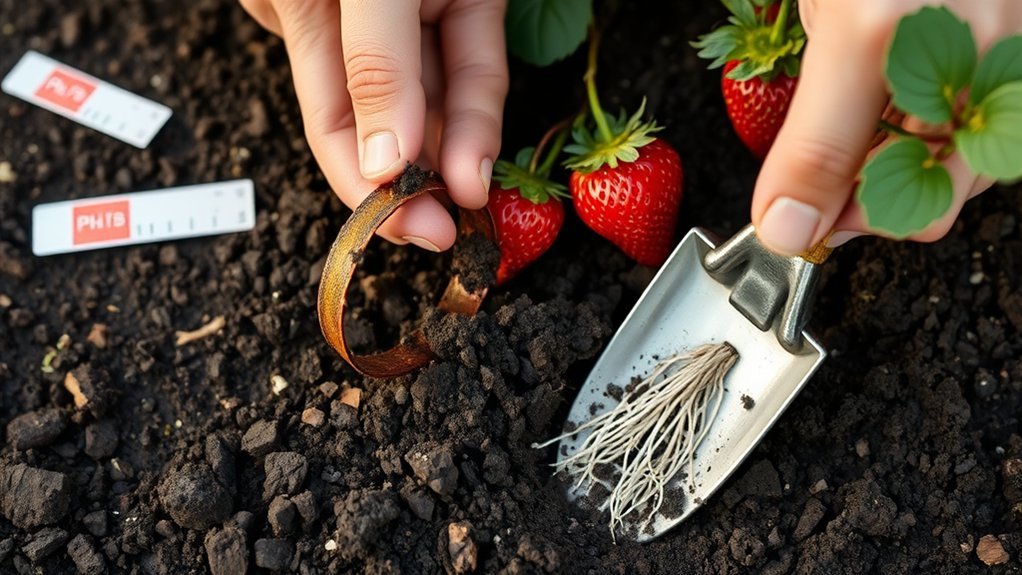
Before planting your strawberries, test the soil pH to confirm it falls between 5.3 and 6.5. This range supports strong root growth and fruit production.
To create a well-draining environment and promote healthy strawberry roots, amend the soil thoughtfully.
Here’s how you can prepare your soil:
- Contact your County Extension Office to test the soil pH and nutrient levels
- Amend the soil with organic matter like well-rotted compost
- Mix 60% topsoil, 30% stone grit, and 10% compost for ideal texture
- Avoid heavy or poorly drained soils to prevent root rot
- Verify soil drains well to support root oxygenation
Soak and Trim Strawberry Roots Before Planting
Before you plant your strawberries, it’s a good idea to soak their roots in water for about 1 to 2 hours. This helps rehydrate them and gives them a nice little boost to get growing.
Now, if you notice the roots are a bit on the long side, go ahead and trim them down to around 4 to 5 inches. This makes sure they fit nicely in the soil and helps prevent problems like J-rooting.
Doing these simple things really pays off because it helps your strawberry plants develop strong roots, which means they’ll be healthier and produce better fruit down the line.
Soaking Duration Tips
Anyone planning to plant bare-root strawberry plants should soak their roots in water for 1-2 hours to rehydrate them and boost healthy growth.
This duration helps soak bare-root strawberry roots thoroughly, ensuring they rehydrate properly to promote healthy growth.
Soaking for too long can cause crown rot, so keep crowns above water. Adding liquid kelp during soaking can further nourish roots. Proper soaking reduces transplant shock and encourages quick establishment.
Keep these tips in mind when soaking:
- Soak roots for 1-2 hours for ideal hydration
- Avoid submerging crowns to prevent rot
- Use liquid kelp solution for added nutrients
- Don’t over-soak to reduce risk of root damage
- Proper soaking helps minimize transplant shock and speeds quick establishment
Following these soaking duration tips sets your strawberry plants up for success.
Root Trimming Techniques
After soaking your strawberry roots to rehydrate them, the next step is trimming them properly. Use root trimming techniques to cut excessively long roots to about 4-6 inches. This prevents J-root formation and helps the roots hang straight down in the planting hole.
When you place the strawberry plants, fan out the roots straight downward to encourage healthy growth. Be careful not to trim roots too short, as this can reduce the plant’s ability to absorb water and nutrients.
Also, make sure the crown of each plant sits even with the soil line; planting too deep or too shallow can cause rot or stunt growth.
Proper root trimming and placement set the foundation for thriving strawberry plants.
Benefits Of Root Preparation
While soaking and trimming your strawberry roots might seem like extra steps, they play an essential role in helping your plants establish quickly and grow strong. Soaking roots for 1-2 hours hydrates them and jumpstarts root zone development.
Trimming long roots to 4-5 inches prevents J-root formation and guarantees a snug fit in the soil around the plant. These preparations reduce transplant shock and promote quicker establishment.
Plus, soaking in water with liquid kelp can boost nutrient uptake, enhancing overall plant vigor.
- Hydrates roots for faster growth
- Fits roots properly into the soil around
- Prevents harmful root curling (J-rooting)
- Lessens transplant shock effects
- Enhances nutrient absorption and vigor
Taking these steps helps your strawberry plants thrive from the start.
Plant at Correct Depth and Spacing for Strong Roots
To grow strong strawberry roots, you need to plant each root at the correct depth and maintain proper spacing. When planting strawberry roots, position the crown right at the soil line to prevent water loss and allow leaves to emerge easily.
Make certain to trim any overly long roots to 4-5 inches to avoid J-rooting and encourage straight growth. After placing the strawberry plant, firm the soil around it to eliminate air pockets and guarantee good root contact, which is essential for strong establishment.
For plant spacing, set individual plants 12 to 18 inches apart, giving them enough room for airflow and growth.
If you’re planting matted rows, space plants 1½-2 feet apart with 3½-4 feet between rows to create a healthy, dense patch.
Water Strawberry Roots Properly to Support Growth
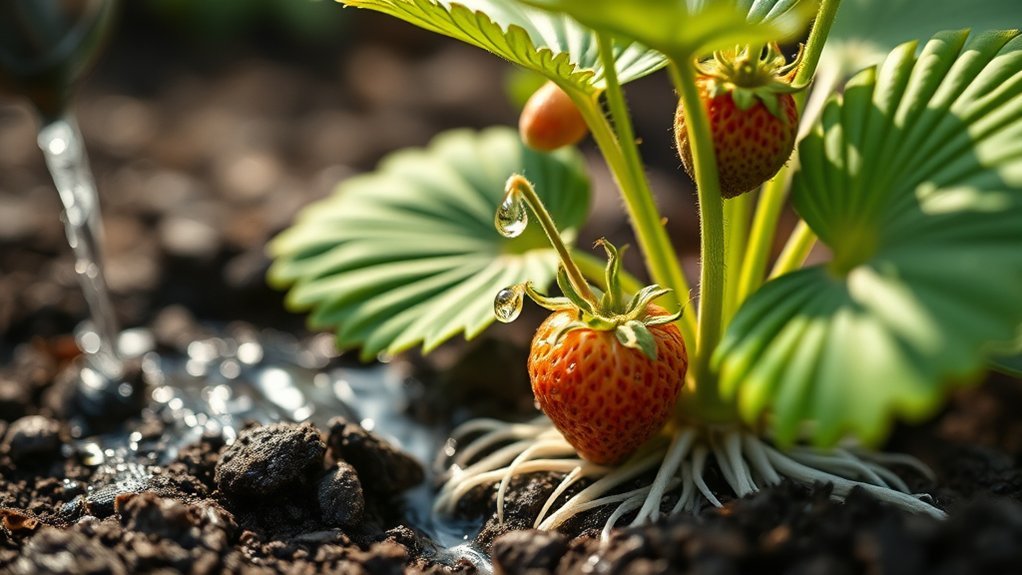
You’ll want to water your strawberry roots about once a week, giving them roughly an inch of water to keep things healthy.
Just be careful not to overdo it—if you notice yellowing leaves or soggy soil, that’s a sign the roots might be getting too much moisture.
It’s a good idea to check the soil regularly so you can find the right balance and help your strawberries grow strong.
Optimal Watering Frequency
Although strawberry plants need consistent moisture to thrive, you shouldn’t overwater them. Overwatering can cause root rot. To get the watering frequency just right, aim to provide about 1 inch of water per week, whether from rain or irrigation.
After planting, water your strawberry roots thoroughly. This helps guarantee good soil moisture and gets rid of air pockets.
Keep soil moisture steady, especially during fruiting, because consistent moisture supports healthy growth and fruit quality.
Check the top ½ inch of soil regularly. Water when it feels dry.
- Provide 1 inch of water weekly
- Water early in the day to reduce leaf moisture
- Water roots thoroughly after planting
- Monitor soil moisture frequently
- Maintain consistent moisture levels during fruiting
Signs Of Overwatering
When strawberry roots sit in soggy soil for too long, they start to rot, showing blackened, mushy roots and a foul smell. These are clear signs of root rot caused by overwatering strawberries.
You might also notice yellowing leaves that look wilted or droopy even though the soil feels moist. This happens because too much water creates an environment perfect for fungal diseases, weakening your plants and reducing fruit production.
To prevent this, make sure your soil is well-drained and avoid standing water around the base of your plants. Only water when the top half-inch of soil is dry, aiming for about an inch of water per week.
Monitoring these signs helps you keep your strawberry roots healthy and thriving.
Mulch to Protect and Nourish Strawberry Roots
A thick layer of straw mulch can shield your strawberry roots from harsh winter temperatures while keeping the soil moist and fertile. By applying 4-6 inches of straw mulch in the fall, you’re protecting them from extreme cold and frost damage.
This organic mulch also helps retain soil moisture, reducing watering needs and preventing erosion. As it breaks down, it enriches the soil, improving soil structure and providing essential nutrients.
Timing is key. Apply mulch after several frosts to avoid hindering spring growth.
- Insulates roots against winter cold
- Maintains consistent soil moisture
- Suppresses weed growth for less competition
- Adds organic matter to enhance soil health
- Prevents soil erosion around plants
Fertilize to Encourage Robust Root Development
After mulching your strawberries to protect and nourish their roots, you’ll want to focus on fertilizing to boost root growth and overall plant health.
To fertilize to encourage robust root development, apply slow-release organic fertilizers right after the first flowers appear.
Incorporate well-rotted compost into the soil each spring before new growth to improve soil structure and nutrient availability.
For Junebearing strawberries, fertilize again after the last harvest in July to replenish nutrients before dormancy.
Day-neutral and Everbearing varieties benefit from monthly fertilizing during their flowering and fruiting period from June to September.
Using organic fertilizers supports steady nutrient release, enhancing root growth and strengthening your plants.
This approach guarantees your strawberry roots develop deeply and healthily for a productive growing season.
Pinch First-Year Blossoms to Strengthen Strawberry Roots
Pinching off first-year blossoms helps your strawberry plants channel their energy into developing strong roots and healthy foliage instead of fruit.
When you pinch first-year blossoms, you boost root strength and encourage healthy foliage growth, setting the stage for a more productive plant.
For Junebearing varieties, remove about two-thirds of the blossoms during the first season to maximize strong roots development.
Even everbearing and day-neutral types benefit from this practice by improving root establishment for future yields.
Everbearing and day-neutral strawberries also gain stronger roots and better future harvests from blossom pinching.
Remember, healthy plants might keep a few buds, but prioritize root strength above all to guarantee vigorous growth.
- Pinch first-year blossoms early in the growing season
- Focus energy on root strength, not fruit
- Remove two-thirds of blossoms for Junebearing varieties
- Encourage healthy foliage to support root systems
- Strengthen roots for abundant future harvests
Train and Manage Runners to Expand Your Strawberry Patch
To expand your strawberry patch effectively, train runners by gently pressing them into the soil to encourage rooting. This helps new plants sprout from the runners, letting you expand your patch naturally.
Manage space by keeping runners within rows and thinning plants to 6-8 inches apart to prevent overcrowding and disease. Once a runner roots well, cut it from the parent plant to promote independent growth.
You can also use containers for some runners to better manage space and simplify harvesting.
| Task | Tip |
|---|---|
| Train runners | Press gently into soil |
| Manage space | Keep runners in rows |
| Thin plants | 6-8 inches apart |
| Cut rooted runners | Separate from parent plant |
| Use containers | Easier expansion & harvest |
Troubleshoot Common Strawberry Root Problems
Training and managing runners helps your strawberry patch grow, but keeping an eye on root health guarantees those new plants thrive.
Troubleshooting common root problems means you’ll want to monitor soil pH, water properly, and control pests to keep roots healthy.
Avoid root rot by making sure your soil drains well and doesn’t stay too wet.
- Keep soil pH between 5.3 and 6.5 for ideal nutrient uptake
- Trim roots to 4-6 inches before planting to prevent J-rooting
- Water only when soil feels slightly dry to avoid overwatering
- Watch for strawberry root weevils and use traps or organic pest control
- Improve drainage to prevent black root rot and other fungal diseases
Frequently Asked Questions
Can Strawberry Roots Be Propagated Indoors Before Transplanting?
Yes, you can propagate strawberry roots indoors before transplanting.
By choosing suitable strawberry varieties, you’ll create ideal growth conditions, like well-draining soil, 65-75°F temperatures, and at least six hours of sunlight daily to encourage strong root development.
Keep the soil slightly moist without overwatering.
Monitor transplant timing carefully. Once roots are robust and frost risk passes, gradually acclimate the plants outdoors for successful transplantation.
How Do Soil pH Levels Affect Strawberry Root Growth?
Imagine your strawberry roots throwing a party, but soil acidity crashes it, messing with nutrient availability.
When pH dips below 5.3, essential nutrients vanish, stunting root development.
Above 6.5? Iron chlorosis shows up uninvited, turning leaves yellow and roots weak.
You’ll want to do pH testing regularly to keep the soil just right for your strawberry varieties.
Otherwise, your plants won’t thank you for the chaotic bash underground.
What Pests Specifically Target Strawberry Roots Underground?
You’ll find root nematodes and soil pests like root weevils specifically targeting strawberry roots underground.
Aphid infestations don’t directly hit roots but weaken your plants, making them more vulnerable to fungal threats and root damage.
To protect your strawberries, you’ll want to focus on pest control strategies that manage these underground threats effectively.
Proper soil management and crop rotation can also help keep these pests at bay and support healthy root growth.
Are There Natural Remedies to Heal Damaged Strawberry Roots?
Imagine your strawberry roots as a fragile ship weathering a storm. To help it sail smoothly again, you can use natural fertilizers like compost tea to nourish its crew and organic mulching to calm the seas.
Root pruning trims damaged parts, while beneficial nematodes act as vigilant sailors protecting against pests.
Together, these remedies restore strength and vigor, letting your strawberry roots thrive naturally and bounce back from damage.
How Long Do Strawberry Roots Take to Establish After Planting?
Strawberry root establishment time typically takes about 4 to 6 weeks after planting.
To speed this up, you’ll want to focus on proper planting techniques like spacing and soil preparation.
Keep your watering frequency consistent to maintain moist, not soggy, soil.
Make sure your plants get plenty of sunlight, around 6-8 hours daily, to support nutrient uptake.
This balanced care helps your strawberry roots establish strong foundations for healthy growth.
Conclusion
By choosing the right strawberry variety and planting at the right time, you set the stage for strong roots. Imagine Sarah, who soaked and trimmed her bare-root strawberries before planting in nutrient-rich soil.
She pinched first-year blossoms and managed runners carefully, resulting in a thriving patch with robust roots. With proper care and attention, your strawberry plants will develop healthy roots that support abundant, sweet fruit season after season.