

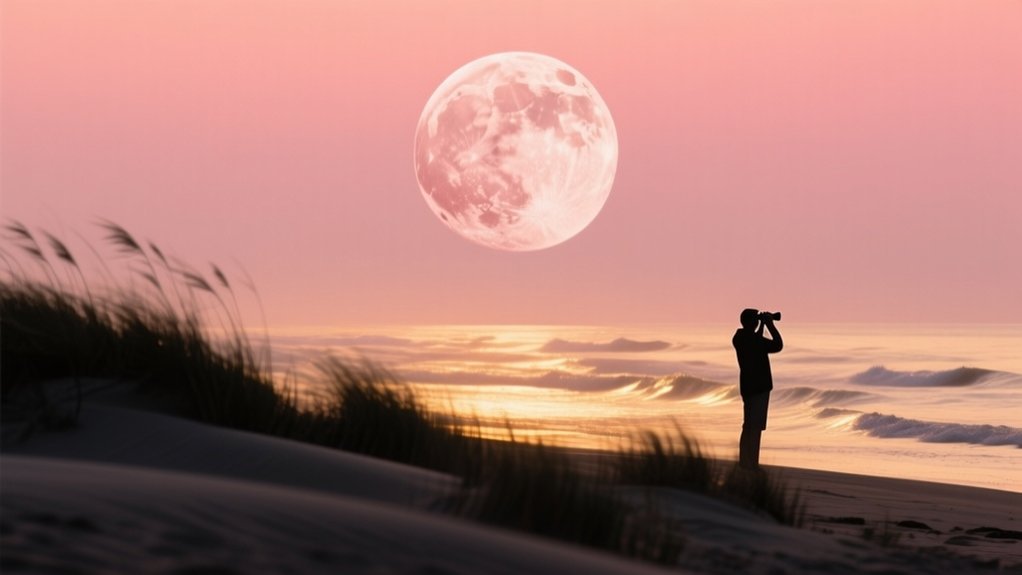
7 Key Facts About the Strawberry Moon in June 2025
You’ll see the 2025 Strawberry Moon on June 11, a rare event when the full moon climbs the lowest in the sky since 2006 due to an 18.6-year lunar standstill.
The name comes from Algonquin tribes marking strawberry harvests, also tied to European traditions like Honey Moon. Its reddish glow results from atmospheric effects at low angles.
For the best views, find dark, clear spots. Curious about its cultural meaning and linked celestial events?
What Is the Strawberry Moon and Where Does the Name Come From?
Although the Strawberry Moon will rise on June 11, 2025, you might wonder why it’s called that. The name “Strawberry Moon” comes from Native American tribes, particularly the Algonquin, who used it to mark the time when wild strawberries ripen.
This full moon signals the start of berry harvesting, a vital seasonal event.
What’s unique about this Strawberry Moon is its low position in the sky, caused by a Major Lunar Standstill that happens every 18.6 years. This makes the moon appear closer to the horizon, often casting amber hues and a rosy glow.
When and How Did the 2025 Strawberry Moon Reach Its Peak?
The 2025 Strawberry Moon reached its peak illumination at 3:44 A.M. ET on June 11.
The 2025 Strawberry Moon peaked in brightness at 3:44 A.M. ET on June 11.
You could catch the best view during moonrise on June 10 at dusk, when the moon cast a warm amber glow across the southeastern U.S.
This Strawberry Moon stood out because it was the lowest full moon observed since 2006.
That’s due to a major lunar standstill, a rare event happening every 18.6 years, which affects the moon’s path across the sky and its apparent altitude.
Thanks to this standstill, the moon reached its peak illumination while appearing unusually low in the sky.
If you were in the South Pacific, you might’ve even seen the moon occult the red supergiant star Antares during this event.
Why Was the 2025 Strawberry Moon So Low in the Sky?
Several factors combined to make the 2025 Strawberry Moon appear unusually low in the sky. The main reason is the major lunar standstill, a rare event happening every 18.6 years that alters the moon’s path, causing it to rise and set at extreme points. This time, it made the Strawberry Moon the lowest full moon since 2006.
If you’re in the northern hemisphere, you’ll notice the moon tracing the shallowest arc across the sky, a sight not to be seen again until 2043.
The sun’s gravitational pull also influenced the moon’s orbit during this cycle. Because the moon stays low, its light passes through more atmosphere, giving the Strawberry Moon a deeper reddish hue at moonrise and moonset.
How Do Atmospheric Conditions Affect the Strawberry Moon’s Reddish Glow?
When the Strawberry Moon rises or sets, its light has to travel through a thicker layer of the atmosphere. This scatters the shorter blue wavelengths, allowing those beautiful red hues to shine through.
It’s pretty cool how the atmosphere plays a role in what we see!
Now, weather conditions like humidity, dust, or pollution can actually make the moon’s reddish glow even more vivid.
So, if the air is a bit hazy or there’s extra dust floating around, that warm red color might really pop.
But remember, clear skies are key if you want to see the moon’s true color without any interference.
On a crisp, clear night, the Strawberry Moon’s glow looks its best!
Moonlight Through Thick Atmosphere
As you watch the Strawberry Moon hang low on the horizon, you’ll notice its reddish glow intensifies because moonlight travels through a thicker layer of Earth’s atmosphere.
This moonlight through thick atmosphere filters shorter wavelengths, making the moon appear reddish in color.
During the June 2025 Strawberry Moon, this effect is especially vivid since it will be the lowest full moon since 2006.
Clear skies play an essential role in enhancing the moon’s amber and rosy hues, so you’ll want a cloud-free night for the best view.
Here’s what influences the glow:
- Moon’s low position increases atmospheric thickness
- Shorter blue wavelengths scatter away
- Longer red and orange wavelengths dominate
- Atmospheric clarity guarantees vibrant colors
Enjoy the spectacular reddish glow of the Strawberry Moon under clear skies!
Scattering of Light Waves
Although the Strawberry Moon’s reddish glow captivates many, it’s the scattering of shorter light wavelengths that truly shapes its warm colors.
As the moon rises and sets near the horizon, its light passes through a thicker layer of atmosphere, causing shorter blue and green wavelengths to scatter out.
This leaves the longer red and orange wavelengths more visible, creating that signature reddish glow.
Atmospheric conditions like humidity and air pollution add particles that enhance this scattering effect, intensifying the moon’s warm hues.
When you observe the Strawberry Moon from a place with clear skies and minimal light pollution, you’ll notice its colors more vividly.
Understanding the scattering of light waves helps you appreciate how the atmosphere influences the Strawberry Moon’s beautiful reddish glow.
Weather Impact on Hue
You’ll notice the Strawberry Moon’s reddish glow changes depending on the weather conditions around you.
The weather impact on hue is significant because atmospheric conditions like humidity and air particles scatter the moonlight, enhancing its warm, amber tones.
When the Strawberry Moon hangs low, its light travels through more atmosphere, intensifying that reddish glow.
However, clouds or haze can dull the colors, making clear skies crucial for the best view.
- Humidity and particles intensify the reddish glow
- Low moon position boosts warm hues
- Clear skies guarantee ideal visibility
- Major Lunar Standstill affects the moon’s path and colors
These factors combine to create the vibrant, striking colors you see during the June 2025 Strawberry Moon.
What Cultural and Historical Significance Does the Strawberry Moon Hold Across Indigenous and European Traditions?
You’ll find that the name “Strawberry Moon” comes from Algonquin tribes marking the wild strawberry harvest in June.
It’s pretty cool how this moon signaled an important time for gathering fresh strawberries, which were a big deal in their culture.
On the other hand, European traditions have their own take. They often called it the Honey Moon or Mead Moon, connecting it to marriage celebrations and the gathering of honey.
So, this moon was kind of like a symbol of sweetness and new beginnings.
Both cultures used this moon to track seasonal changes tied to agriculture and natural cycles.
It’s fascinating how, despite coming from different parts of the world, they both saw this moon as a marker for important moments in nature and life.
Indigenous Naming Origins
Since the Strawberry Moon marks the ripening of wild strawberries in June, Indigenous American Algonquin tribes named it to reflect this essential seasonal event.
You’ll find that many Indigenous names for the June full moon highlight key agricultural practices tied to the season’s natural rhythms.
These names show how closely Indigenous communities tracked lunar cycles to guide planting and harvesting.
The Tlingit called it the “Birthing Moon,” symbolizing renewal.
The Cherokee referred to it as the “Green Corn Moon,” marking crop readiness.
The Algonquin’s “Strawberry Moon” signaled strawberry harvest time.
Indigenous names emphasize the moon’s role in sustaining food sources.
These names deepen your understanding of Indigenous connections to nature and agriculture through lunar observation.
European Moon Names
Although the Strawberry Moon is well known among Indigenous communities for signaling the strawberry harvest, European traditions give this full moon different names that reflect their own seasonal markers. You’ll find it called the Honey Moon, marking the honey harvest, or the Rose Moon, celebrating blooming roses.
Some even know it as the Blooming Moon, highlighting nature’s fertility. These European moon names connect you to the rhythm of the natural world just as Indigenous names do.
| Name | Origin | Significance |
|---|---|---|
| Strawberry Moon | Indigenous | Strawberry harvest |
| Honey Moon | European | Honey harvest |
| Rose Moon | European | Blooming roses |
| Blooming Moon | Various cultures | Seasonal growth |
| Birth Moon | Various cultures | Fertility and renewal |
Seasonal Agricultural Significance
When you observe the Strawberry Moon, you’re witnessing a natural signal deeply rooted in both Indigenous and European agricultural traditions. This full moon marks a significant period tied to planting, harvesting, and fertility. It reflects the agricultural significance embedded in lunar cycles.
Indigenous tribes, like the Algonquian and Cherokee, used this moon to guide their seasonal activities. The Strawberry Moon signals when wild strawberries ripen, a key harvest time for Indigenous tribes. Cherokee called it the Green Corn Moon, indicating crop tending and early summer harvests.
Many Indigenous tribes used lunar cycles as natural calendars for gathering and farming. Europeans linked this moon to marriage and fertility, naming it the Honey or Mead Moon.
Understanding these traditions connects you to the rhythms of nature and history.
Which Locations Offered the Best Viewing Opportunities for the 2025 Event?
Where could you catch the best view of the 2025 Strawberry Moon? The best viewing opportunities were definitely in locations with minimal light pollution, such as rural areas and national parks.
These spots allowed you to experience superior viewing conditions, especially elevated locations where the moon’s low position was clearer.
The southeastern U.S. stood out, offering spectacular views during moonrise, with the moon casting a warm amber hue that enhanced the experience.
The southeastern U.S. provided stunning moonrise views with a warm amber glow enhancing the 2025 Strawberry Moon experience.
To get the most out of your observation, give your eyes about 20 minutes to adjust to the darkness before watching.
Using binoculars or a small telescope also helped you see detailed lunar features, making the event even more rewarding under these ideal conditions.
Which Notable Celestial Events Occurred Near the 2025 Strawberry Moon?
Besides the stunning views of the Strawberry Moon itself, 2025 offers several other remarkable celestial events you won’t want to miss. As you gaze at the night sky, you’ll notice a series of events surrounding the Strawberry Moon that make this year special for skywatchers.
These celestial events enhance the excitement and offer multiple opportunities to connect with the cosmos.
- A partial solar eclipse on March 29, 2025, set the stage for an extraordinary year.
- The Strawberry Moon in June 2025 appears as the lowest full moon since 2006, making it uniquely visible.
- A total lunar eclipse occurs on September 7, 2025, just weeks after the Strawberry Moon.
- Saturn shines exceptionally bright two weeks after the lunar eclipse, adding to the night sky’s wonders.
These events make 2025 a thrilling year for astronomy enthusiasts.
Frequently Asked Questions
Can the Strawberry Moon Be Seen From the Southern Hemisphere?
Yes, you can see the Strawberry Moon from the Southern Hemisphere, though it might appear lower in the sky.
When you check the Moon Phases, you’ll notice this full moon has special cultural significance, often linked to seasonal changes.
To get the best view, consider your local viewing conditions.
Find a spot with clear skies and minimal light pollution.
This way, you won’t miss the warm amber glow unique to this moon.
Does the Strawberry Moon Affect Tides or Marine Life?
You might think the Strawberry Moon doesn’t impact much beyond looking pretty, but it actually affects tidal patterns greatly.
The moon phases, especially full moons like the Strawberry Moon, intensify the lunar influence on Earth’s tides. This causes higher highs and lower lows.
This shift also alters marine behavior. Many fish and crustaceans become more active, using the brighter light for feeding and spawning.
Are There Any Superstitions Associated With the Strawberry Moon?
Yes, you’ll find plenty of moon folklore tied to the Strawberry Moon.
People believe it symbolizes abundance and fertility, linking it closely with harvest beliefs.
Seasonal rituals often honor this full moon to celebrate nature’s cycles, using its light to encourage growth and prosperity.
If you follow these traditions, you’ll see the Strawberry Moon as a powerful symbol of nature’s bounty and a time for new beginnings.
How Long Does the Strawberry Moon Remain Fully Visible?
The moon visibility duration for the Strawberry Moon extends beyond just one night, thanks to the lunar cycle impact that guarantees it’s fully illuminated for several days around its peak.
When you check the astronomical events calendar, you’ll see that this June moon significance means you have multiple chances to catch its glow.
Can the Strawberry Moon Be Photographed With a Smartphone?
You know what they say: “The best camera is the one you have with you.”
Yes, you can definitely capture the Strawberry Moon with smartphone photography.
For the best settings, use night mode and stabilize your phone on a tripod or steady surface.
Follow moon photography tips like shooting during moonrise and avoiding digital zoom.
Conclusion
As you looked up at the 2025 Strawberry Moon, you might’ve felt a rare connection. Its low, reddish glow perfectly mirrored the warmth of summer’s first fruits.
It’s no coincidence that this moon, steeped in history and culture, appeared just as you needed a moment of calm and wonder. Whether you caught it from your backyard or a distant shore, the Strawberry Moon invited you to pause and share in a timeless, celestial embrace.