
What Color Is the Strawberry Moon?
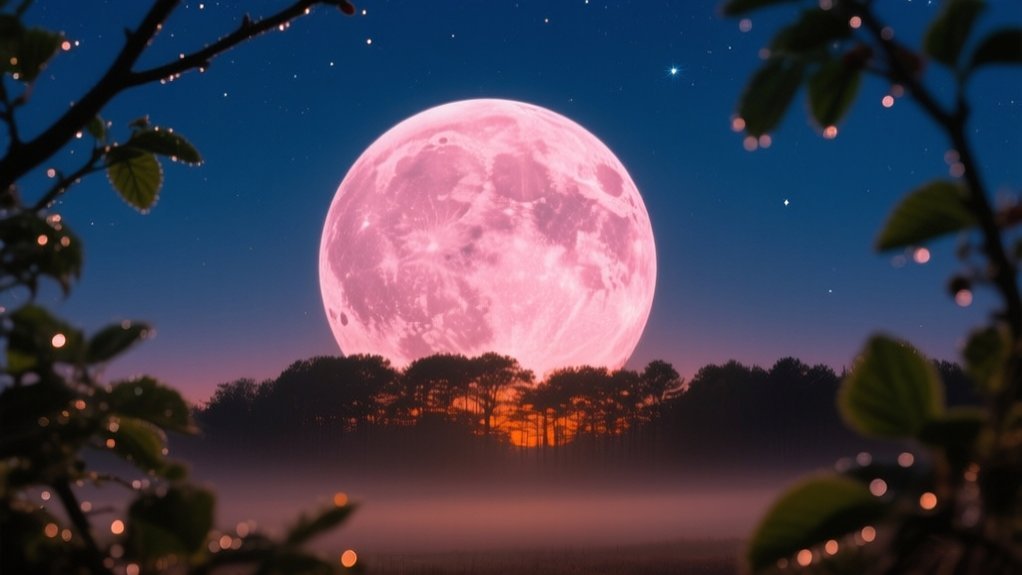
You’ll usually see the Strawberry Moon as a pale white glow, but near the horizon, it often takes on warm red, orange, or pink shades. This happens because the moonlight passes through more of Earth’s atmosphere, scattering blue light and letting warmer colors shine through.
Dust or smoke in the air can make these colors even more vibrant. If you want to understand why these hues appear and the best times to catch them, there’s more to uncover.
What Colors Does the Strawberry Moon Appear As?
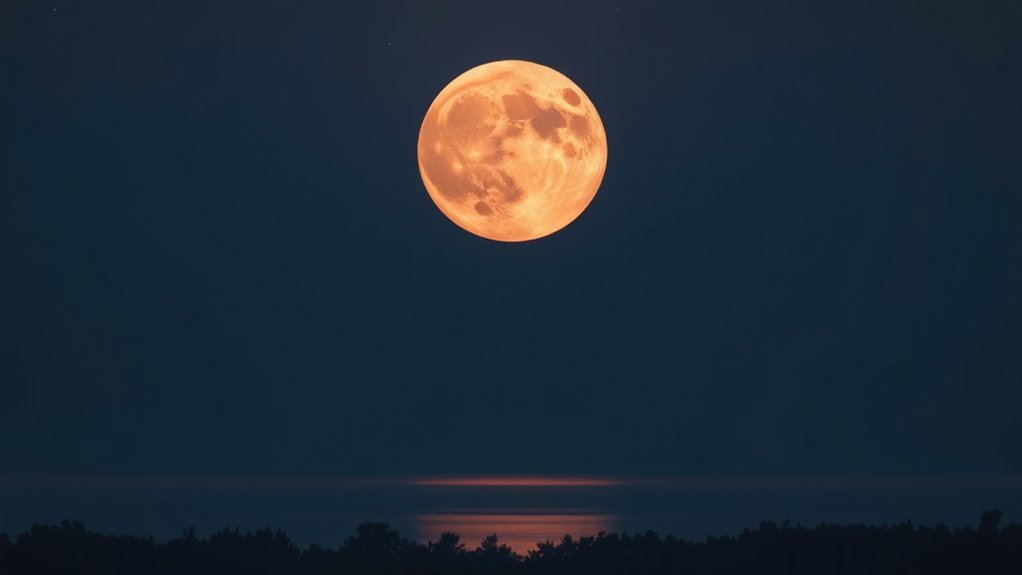
Although the Strawberry Moon is named after the June strawberry harvest rather than its color, you might notice it appearing in shades of red, orange, or pink when it rises near the horizon.
This happens because of atmospheric scattering, where the increased density of the atmosphere at lower angles bends light rays, giving the moon a warmer hue.
You may see the Strawberry Moon exhibiting a reddish-pink color, especially when dust or smoke enhances the effect.
These atmospheric conditions can create variations, making the moon look more vibrant or tinted with soft pinks and oranges.
Why Does the Strawberry Moon Sometimes Look Red or Orange?
You may have noticed the Strawberry Moon sometimes glows with striking red or orange hues, especially when it’s near the horizon. This happens because the Moon’s light travels through a thicker layer of Earth’s atmosphere at that angle.
The atmosphere scatters shorter blue wavelengths of light while allowing the reddish colors to pass through more directly. Environmental factors like Saharan dust or wildfire smoke can intensify this effect, making the Moon appear even more vibrant.
As the Moon rises higher, you’ll see it turn whiter since it passes through less atmosphere.
How Does the Moon’s Position Affect Strawberry Moon Colors?

When the Strawberry Moon hangs low near the horizon, its light travels through more of Earth’s atmosphere, which deepens its reddish color. This atmospheric effect bends and scatters the moon’s hue, making it richer and more vibrant.
As you observe the Strawberry Moon, you’ll notice its appearance changes depending on its position in the sky.
Here’s how the moon’s position affects what you see:
- Low on the horizon, the moon appears redder or orange.
- Higher up, its color shifts to a paler, whiter tone.
- The thicker atmosphere near the horizon enhances scattering.
- Your location influences the intensity of the moon’s appearance.
- Viewing just after sunset or before sunrise maximizes color impact.
Understanding this helps you better appreciate the Strawberry Moon’s stunning colors.
How Do Atmospheric Conditions Change the Strawberry Moon’s Color?
Besides the moon’s position, atmospheric conditions play a big role in shaping the Strawberry Moon’s color. When the Moon is near the horizon, light must pass through more atmosphere. This scatters shorter wavelengths and enriches the reddish hue you see.
Dust and smoke particles in the air also influence this effect, intensifying the color variations.
| Atmospheric Conditions | Effect on Light | Resulting Color |
|---|---|---|
| Clear sky | Minimal scatter | Pale or white |
| Dust or smoke present | Increased scatter | Deep reddish or orange |
| Low moon position | Thick atmosphere | Enhanced reddish hue |
You’ll notice how these conditions combine to create the unique and enchanting shades of the Strawberry Moon.
Can Dust and Smoke Make the Strawberry Moon Look More Vibrant?
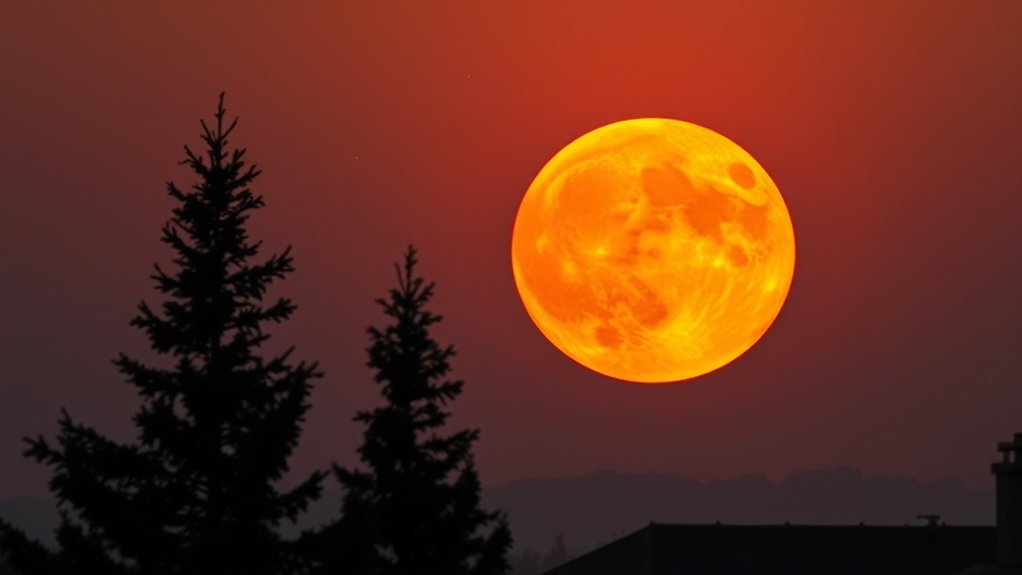
You might notice the Strawberry Moon looking even more vibrant when dust and smoke fill the atmosphere.
These tiny particles scatter light, enhancing the moon’s reddish and orange hues. Especially near the horizon, dust from places like the Sahara or smoke from wildfires can make the colors pop in surprising ways.
It’s pretty cool how something as simple as dust or smoke can add such a dramatic effect to the moon’s appearance.
Atmospheric Particles Enhance Color
Although the Strawberry Moon naturally glows with a soft reddish tint, dust and smoke particles in the atmosphere can make its colors pop even more vividly.
These atmospheric particles scatter sunlight, enhancing the moon’s reddish hue and overall color intensity.
When you catch the moon low on the horizon, you’ll notice its light travels through a thicker layer of atmosphere, rich with dust and smoke, which amplifies its warm tones.
Saharan dust creates a striking reddish tint during moonrise in the Southeast.
Smoke from Canadian wildfires alters light scattering, intensifying colors.
The combined effect of dust and smoke boosts the moon’s vibrancy.
Atmospheric particles filter sunlight, enriching the moon’s reddish hue.
The denser atmosphere near the horizon enhances the Strawberry Moon’s color.
Effects Of Dust And Smoke
When dust and smoke fill the atmosphere, they can dramatically enhance the Strawberry Moon‘s vibrant appearance.
You’ll notice that Saharan dust often enriches the Moon’s color, contributing to vivid sunrises, sunsets, and a striking lunar glow.
Smoke from events like Canadian wildfires scatters light in a way that amplifies the reddish hues you see on the Moon’s surface.
When the Moon sits low on the horizon, its light travels through more atmospheric layers filled with dust and smoke, making it look larger and more colorful.
If you’re in an area affected by these airborne particles, you’ll likely experience a more intense reddish tint during the Strawberry Moon, making it a truly unique and memorable sight in the night sky.
How Does Location Influence the Strawberry Moon’s Appearance?
Where you watch the Strawberry Moon from can actually change how it looks, and that’s because of things like the atmosphere around you and the angle you’re viewing it from.
For example, when the Moon is low on the horizon, it often looks bigger and more colorful. That’s because the light has to pass through more of the Earth’s atmosphere, which can make the colors pop.
You might also notice that if you’re in a place with different air quality or higher elevation, the Moon’s color can shift quite a bit—from a cool, silvery glow to warm reds and oranges.
Atmospheric Effects On Color
Because the Strawberry Moon‘s light travels through more of Earth’s atmosphere when it sits low on the horizon, you’ll often see it take on a deeper reddish hue.
This happens as atmospheric conditions like dust and smoke scatter shorter light rays, letting the longer red wavelengths dominate. Depending on where you are, these factors can drastically change the Moon’s color.
Consider these influences on the Strawberry Moon’s appearance:
- Dust and smoke particles intensify the reddish hue.
- Light rays bend more through denser atmospheric layers.
- Clear horizons reveal stronger color shifts.
- Urban light pollution can dull the Moon’s vibrancy.
- Environmental events, like wildfires or Saharan dust, amplify color changes.
Viewing Angles And Location
Although the Strawberry Moon’s reddish glow often catches your eye near the horizon, the location where you observe it plays an essential role in how vibrant and large it appears.
When you watch from a low elevation with an unobstructed horizon, the viewing angles cause the Moon’s light to travel through more atmospheric conditions, scattering shorter wavelengths and enhancing its reddish-pink hue.
Dust or smoke in the air can intensify these colors, making the Moon appear even more vivid. Conversely, if you’re in an urban area with heavy light pollution, the colors might seem muted.
Also, the Moon looks larger and more colorful when low on the horizon compared to high overhead.
When Is the Best Time to See the Strawberry Moon’s Colors?
When can you catch the Strawberry Moon showing off its most vivid colors? The best time is during its rise and set, especially when it’s near the horizon. This low angle lets you see the Moon’s reddish hues intensified by Earth’s atmosphere.
Around June 29, 2026, at 7:56 P.M. Eastern Time, the Strawberry Moon reaches peak illumination, making it even more vibrant. Here’s when to look:
- Just after moonrise and before moonset near the horizon
- After midnight (Pacific time) for clearer color visibility
- Around 3 a.m. (Eastern time) when brightness peaks
- On nights with dust or smoke in the atmosphere
- During the days surrounding peak illumination for pink or orange shades
Catch the Strawberry Moon then, and you won’t miss its stunning display.
Why Is It Called the Strawberry Moon?
You might be wondering why it’s called the Strawberry Moon, especially since it doesn’t actually look red or pink.
Well, the name comes from Native American tribes who used it to mark the time when strawberries are ripe for harvest.
So, it’s really about connecting the moon to the seasons and farming cycles.
This nickname shows how important the timing of fruit picking was in early summer.
Pretty cool, right?
Name Origin Explained
Several Native American Algonquian tribes named the June full moon the “Strawberry Moon” because it marks the time when strawberries ripen for harvest.
Understanding the origin of the name helps you appreciate its cultural significance rather than its actual color.
The moon itself isn’t reddish-pink by nature; that hue you sometimes see is due to atmospheric effects at moonrise.
Here’s what you should know about the name origin:
- The name reflects the season of strawberry harvesting.
- It symbolizes agricultural abundance and seasonal change.
- The term doesn’t describe the moon’s true color.
- Alternative names include “Rose Moon” and “Honey Moon.”
- The reddish-pink tint often seen is caused by Earth’s atmosphere, not the moon itself.
This name connects you to nature and traditional cycles.
Seasonal Harvest Link
Because the Strawberry Moon signals the peak of strawberry ripening, it marks an important time for harvest in the northeastern U.S.
When you see this full moon, you’re witnessing a natural calendar that Native American tribes, like the Algonquian, used to guide their seasonal harvest.
They named this full moon the Strawberry Moon because it told them when June-bearing strawberries were ready to pick. This name doesn’t describe the moon’s color but highlights the abundance of ripe strawberries available during this period.
You can think of the Strawberry Moon as a reminder of nature’s cycles, helping people track seasonal changes and plan agricultural activities.
Cultural Significance
Although the Strawberry Moon doesn’t actually appear red or pink, its name carries deep cultural meaning tied to the time when June-bearing strawberries are ready to harvest.
The Full Moon in June, known as the Strawberry Moon, holds cultural significance rooted in Native American Algonquian traditions. It marks a key moment in the agricultural calendar, signaling the peak of strawberry picking and the shift from spring to summer.
You’ll find this moon also called the Blooming Moon or Green Corn Moon, reflecting diverse cultural views. Here’s why it matters:
- Native American tribes named it for strawberry harvest time
- It signals the start of summer and agricultural milestones
- Represents abundance and seasonal change
- The moon’s hue comes from atmospheric effects, not fruit color
- It connects communities through shared farming traditions and folklore
What Are Common Misconceptions About the Strawberry Moon’s Color?
If you’ve ever heard the name “Strawberry Moon,” you might assume the moon itself turns red or pink during this time.
However, the Strawberry Moon’s name actually comes from the strawberry harvest season, not its color.
Many people think the moon glows with a reddish hue, but that’s mainly due to atmospheric conditions.
When the moon sits low on the horizon, light passes through more air, scattering shorter wavelengths and making it appear orange or pink.
This reddish tint isn’t an inherent feature of the moon but a trick of the Earth’s atmosphere.
How Can You Capture the Strawberry Moon’s Colors in Photos?
How can you make the Strawberry Moon’s subtle colors stand out in your photos? Start by using a camera with manual settings to control exposure and aperture, ensuring the moon’s reddish tones come through.
Shooting during moonrise or moonset helps, as the moon appears redder near the horizon due to atmospheric scattering.
Don’t forget to use a tripod to keep your camera steady during longer exposures, avoiding blur.
Here are some tips to capture the Strawberry Moon’s colors effectively:
- Shoot at moonrise or moonset to enhance the reddish hue
- Use a tripod for sharp, stable images
- Adjust exposure and aperture manually on your camera
- Try a polarizing filter to reduce glare and boost saturation
- Use a telephoto lens to zoom in on the moon’s surface details
Frequently Asked Questions
What Cultural Traditions Are Associated With the Strawberry Moon?
You’ll find that the Strawberry Moon inspires June celebrations rooted in Native American symbolism, marking the time to harvest ripe strawberries and honor agricultural practices.
You can participate in rituals celebrating fertility and abundance, as many tribes associate this moon with marriage luck and animal births.
These traditions connect you to nature’s cycles, encouraging communal gatherings that reflect gratitude for the season’s bounty and the ongoing harmony between people and the land.
Can the Strawberry Moon Affect Tides or Wildlife Behavior?
Yes, the Strawberry Moon affects tide patterns by causing higher high tides and lower low tides due to its lunar effects.
You’ll also notice wildlife migrations and behaviors shift during this time.
Many animals, including fish and birds, rely on the moon’s phases for breeding and navigation.
How Long Does the Strawberry Moon Last Each Year?
Think of the Strawberry Moon as a bright beacon signaling summer’s peak.
You’ll see it fully illuminated for about one night, but it lingers in its moon phases for around three days.
This duration ties closely to lunar cycles, which last about 29.5 days.
Its seasonal significance shines as it marks the June strawberry harvest, making it a special, fleeting moment in the sky each year you won’t want to miss.
Are There Any Festivals or Events Tied to the Strawberry Moon?
Yes, you’ll find plenty of strawberry moon festivals celebrating this lunar event.
These lunar celebrations often coincide with the summer solstice, creating a perfect blend of nature and culture.
You can join strawberry picking, enjoy local foods, or attend moonlit hikes.
Many communities and Native American tribes hold special gatherings honoring the harvest and traditional practices linked to the Strawberry Moon, making it a vibrant time to connect with nature and heritage.
Is the Strawberry Moon Visible Worldwide or Only in Specific Regions?
You can catch the Strawberry Moon’s global visibility from almost anywhere on Earth, but regional variations affect what you actually see.
About 90% of the world’s population has the chance for lunar sightings during this event.
Atmospheric conditions and your location can change the moon’s hue and timing.
Conclusion
You might think the Strawberry Moon is always pink or red, but its color actually changes based on the moon’s position and the atmosphere. Sometimes it looks pale white or soft orange instead.
Don’t worry if you don’t see bright colors every time. These variations are natural and just as beautiful. So next time the Strawberry Moon rises, take a moment to enjoy its unique glow, no matter the shade you spot.